Capital Gains Tax Explained: Rates, Rules & Examples

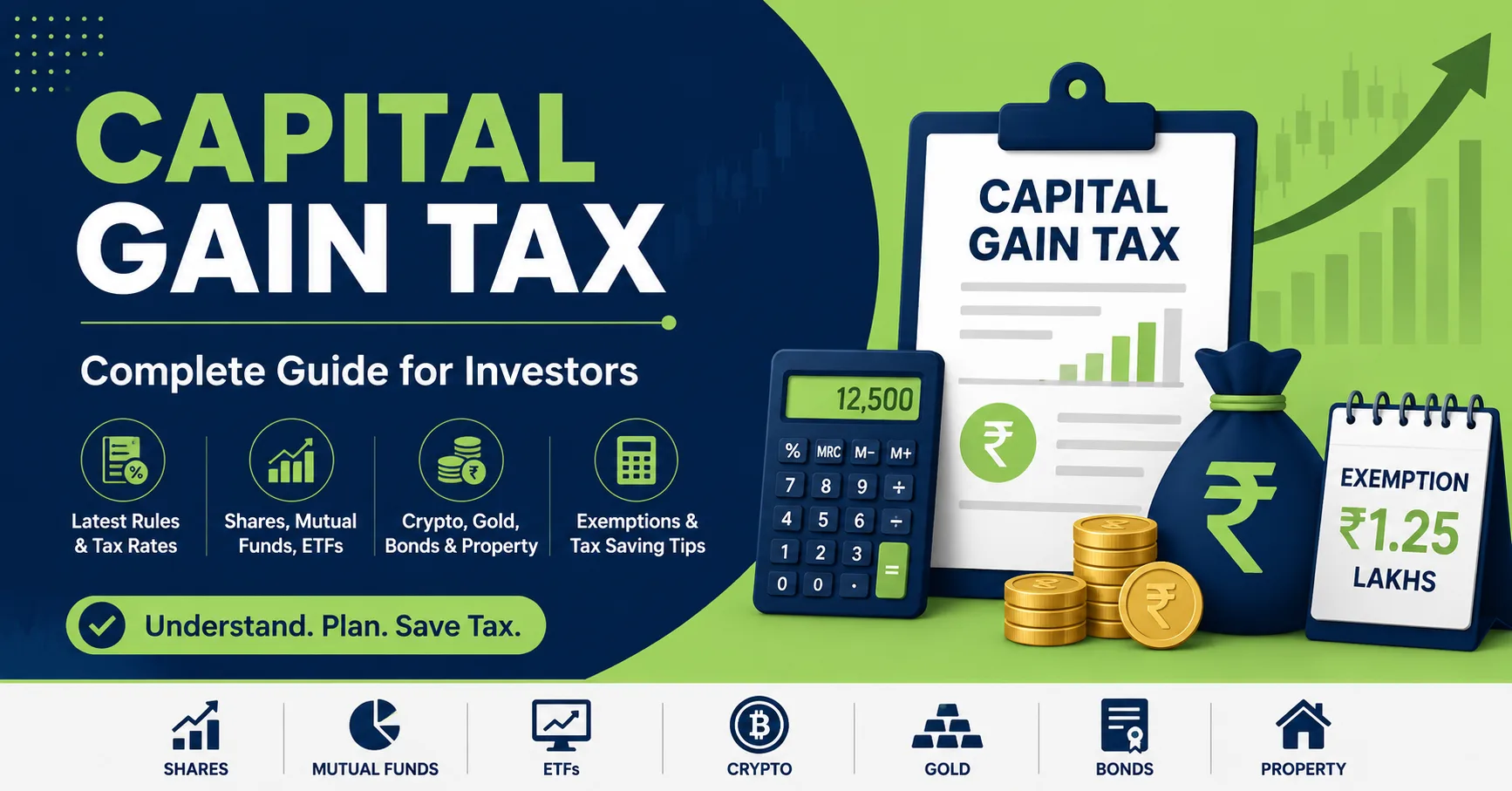
Capital Gains Tax Explained

Understand capital gains tax on shares, mutual funds, ETFs, crypto, gold, bonds, and property, with clear rules, rates, and filing tips using ClearTax.

Why Capital Gains Tax Matters for Investors

A self-employed individual, have a number of expenses, and I also pay a lot of taxes.

Different Types of Taxes You Already Pay

There is GST (Goods and Services Tax). I pay the editor, the researcher. Then there is income tax to be paid, which reduces the money I get to use for household expenses like food, daily needs, and of course, investing.

Why Capital Gains Tax Feels Complicated

The sad part is that this is not the end of it. The money I make from investing interest on FDs, dividends on shares these are all taxed. Capital Gains Tax, which are the profits one makes from selling different assets like stocks, mutual funds, gold, property, crypto, etc., are also taxed.

Have tried to simplify it as much as possible. But I must say, taxation is not at all simple. Just compiling all this information took me almost a full day, with different sources presenting different information.

Disclaimer Before We Begin

While you consider some of the material here, I urge you to do your own research and, if possible, consult a tax advisor.

Capital Gains on Equity Shares

As you all know, these are of two types.

Listed vs Unlisted Equity Shares

Listed shares are those we purchase via trading accounts like Zerodha, Groww, etc. There are also unlisted shares, which are bought via online and offline brokers.

How Capital Gain Is Calculated

In either case, theCapital Gains Tax is calculated as the difference between the price at which you bought the shares and the price at which you sell them.

Practical Example of Equity Capital Gain

For example, I bought 500 shares of Fortis Healthcare at ₹500 each on 1st August 2024. This was last year. Today, the price is roughly ₹950 per share. So, ₹950 minus ₹500 multiplied by 500 shares comes to ₹2,25,000. That is my capital gain, and it is this amount on which capital gains tax needs to be calculated as per the current tax rules.

Factors That Decide Capital Gains Tax

Now, how much is this tax? Well, it depends on a few factors four of them, actually.

First, there is the type of shares. Listed and unlisted shares have different rules, not only in terms of tax rates but also the eligible holding period.

Holding Period Rules for Listed and Unlisted Shares

In case, Fortis Healthcare is a listed share, and because I have held it for more than 12 months, this transaction is tagged as long-term capital gain. Please note that it is 12 months in the case of listed shares, and for unlisted shares, the holding period eligibility is 24 months.

Role of STT and Capital Gain Amount

STT, or Securities Transaction Tax, is also a factor. Depending on whether it is paid or not, different tax rules apply. Finally, there is the amount of capital gain.

LTCG Exemption Limit Explained

As per current rules, there is an exemption of ₹1.25 lakh per financial year. On LTCG of ₹2,25,000, I can avail an exemption of ₹1,25,000, which brings my taxable long-term Capital Gains Tax down to ₹1,00,000.

Understanding the ₹1.25 Lakh LTCG Exemption and Tax Calculation

At 12.5%, the tax comes to ₹12,500.

₹1.25 Lakh Exemption Is an Annual Aggregate Limit

Please note that this ₹1.25 lakh exemption is not per transaction. It is an aggregate limit for the entire financial year. So, if I had sold more shares and had, say, ₹20 lakhs of LTCG, the exemption of ₹1.25 lakhs would apply to the total ₹20 lakhs, not per transaction or per share type.

How Transaction Date Impacts Capital Gains Tax

Just to give you a sense of how complex this can get, look at this table and notice how your taxes change depending on the date of transaction, such as 23rd July 2024 in this case. This gives you a glimpse of how complicated our tax lives can be.

Simplifying Capital Gains Tax Filing with ClearTax

That complexity is exactly where ClearTax comes in. As India’s most popular online tax filing service, ClearTax makes this process extremely simple.

Automatic Pre-Filling of Tax Information

You just log in to your ClearTax account, enter your PAN details, and the ClearTax workflow automatically connects with the Income Tax Department to pre-fill up to 95% of your Capital Gains Tax information.

Uploading Form 16 and Salary Details

You can also upload your Form 16 as a PDF, and the platform instantly fetches all your salary details.

Importing Investment Data from Brokers

For investors earning gains from stocks, mutual funds, F&O, etc., simply click on “Add Details.” You will see integrations with more than 80 brokers across stocks, mutual funds, F&O, US stocks, and even crypto wallets.

Auto-Importing Transactions from 80+ Brokers

From there, it is almost effortless. Select your trading platform, click on login and import, sign in to your broker account, and let Capital Gains Tax ClearTax pull in all your transaction data whether it is five entries or five hundred.

Manual P&L Upload Option

There is also a second option where you can manually import your P&L statement from the broker platform. Within seconds, your Capital Gains Tax are neatly classified as long-term, short-term, intraday, and even F&O.

Automatic Capital Gains Classification and ITR Selection

Just review the information, confirm your deductions, and ClearTax will generate a complete tax summary of your income, savings, taxes paid, refunds, etc. It will also automatically select the correct ITR form and the best tax regime to maximize your refund.

Carry Forward and Set-Off of Past Losses

Here’s the best part: if you have reported any capital or trading loss in the previous eight years, ClearTax will automatically fetch it and adjust it against your current gains. Then, simply click on “File Now,” and you’re done simple, fast, and accurate.

Capital Gains Tax on Mutual Funds

Now, move on to mutual funds.

Types of Mutual Funds Based on Asset Allocation

As we all know, there are equity funds, debt funds, and hybrid funds, which can be further classified based on the percentage of equity they hold.

Taxation of Equity-Oriented Mutual Funds

In the case of equity-oriented schemes, the current tax rules are as follows: short-term capital gains (holding period less than 12 months) are taxed at 20%, while long-term capital gains are taxed at 12.5%.

Taxation of Debt-Oriented Mutual Funds

For debt-oriented schemes, the holding period is now irrelevant. Irrespective of how long you hold them, the capital gains are taxed as per your income tax slab.

Tax Treatment of Hybrid Mutual Funds

For hybrid funds and their different variants.

Capital Gains Tax on International Mutual Funds

In addition, there are international funds. If these are held for less than 24 months, the gains are treated as STCG and taxed at slab rates. If held for more than two years, the gains are taxed at 12.5% without indexation.

Capital Gains Tax on ETFs (Exchange Traded Funds)

Next, we have ETFs. Similar to mutual funds, there are equity, bond, gold, and international ETFs.

Taxation of Equity ETFs

Equity ETFs such as Nifty 50, Bank Nifty, sectoral ETFs, and smart beta ETFs are treated like listed equity shares. STCG is taxed at 20%, and LTCG is taxed at 12.5%, with an exemption limit of ₹1.25 lakhs.

Taxation of Debt ETFs

Debt ETFs, such as liquid ETFs and Bharat Bond ETFs, are taxed as per slab rates, irrespective of the holding period.

Taxation of International ETFs

International ETFs, like NASDAQ 100 and FANG Plus, are taxed at slab rates if held for less than 24 months. LTCG is taxed at 12.5% without indexation, and there is no LTCG exemption.

Taxation of Fund of Funds (FOFs)

A common question is about the taxation of fund of funds. Although FOFs are technically mutual funds, the tax treatment depends on the underlying asset.

Equity-Oriented Fund of Funds

Equity-oriented FOFs attract 20% STCG with a holding period of one year, while LTCG is taxed at 12.5%. Debt-oriented FOFs are taxed as per slab rates.

Debt, Gold, and International Fund of Funds

In the case of gold and international FOFs, the holding period is two years. STCG is taxed at slab rates, while LTCG is taxed at 12.5% without any exemption.

Crypto Taxation in India (Virtual Digital Assets)

Crypto, or Virtual Digital Assets, as termed in the Union Budget 2022. This was a landmark moment for digital assets in India.

What Qualifies as a Virtual Digital Asset

VDAs include cryptocurrencies like Bitcoin and Ethereum, as well as NFTs and other digital assets.

Flat 30% Tax, No Deductions, and 1% TDS

Any profits from selling, swapping, or spending crypto assets are taxed at a flat rate of 30%, plus surcharge and cess. No deductions are allowed for expenses such as transaction fees or brokerage. Additionally, a TDS of 1% is levied on all VDA transfers.

Increased Monitoring of Crypto Transactions

Income tax officers are now being trained in blockchain analytics and crypto wallet tracking, so if you hold crypto, please ensure you pay your taxes.

Capital Gains Tax on Gold Investments

Gold has delivered spectacular returns over the last two years, with prices up nearly 75%. This may have tempted many investors to book profits.

Taxation of Physical Gold

For physical gold, short-term capital gains are taxed as per slab rates. Long-term gains (holding period of 24 months or more) are taxed at 12.5% without indexation, and there is no ₹1.25 lakh exemption.

Taxation of Digital Gold

Digital gold is taxed in the same manner as physical gold.

Taxation of Gold ETFs

Gold ETFs are treated differently. If held for less than 12 months, gains are STCG and taxed at slab rates. If held for more than 12 months, LTCG is taxed at 12.5% without indexation and without any exemption.

Taxation of Gold Mutual Funds

Gold mutual funds have a holding period of 24 months. STCG is taxed at slab rates, while LTCG is taxed at 12.5% without indexation.

Capital Gains Tax on Bonds, Debentures, and Property

For bonds and debentures, taxation differs between listed and unlisted instruments.

Listed Bonds and Debentures

Listed bonds held for more than 12 months and where STT is paid attract LTCG tax at 12.5% without indexation. Short-term Capital Gains Tax are taxed at 20% if Section 111A applies; otherwise, slab rates apply.

Unlisted Bonds and Debentures After 23 July 2024

Unlisted bonds and debentures transferred, redeemed, or matured on or after 23rd July 2024 are treated as short-term assets and taxed at slab rates, regardless of holding period.

Capital Gains Tax on Immovable Property

For immovable property, the holding period for LTCG is now 24 months. Properties acquired before 23rd July 2024 can be taxed at 20% with indexation or 12.5% without indexation. Properties acquired after this date are taxed at 12.5% without indexation. STCG is taxed at slab rates.


Income tax scrutiny Notice: Learn what to write in the Remarks section under Section 143(2) to avoid queries, penalties, and delays.

Explore the ultimate comparison of gold vs stock investment returns. We analyze historical performance, risk, and inflation hedging to guide your portfolio strategy.
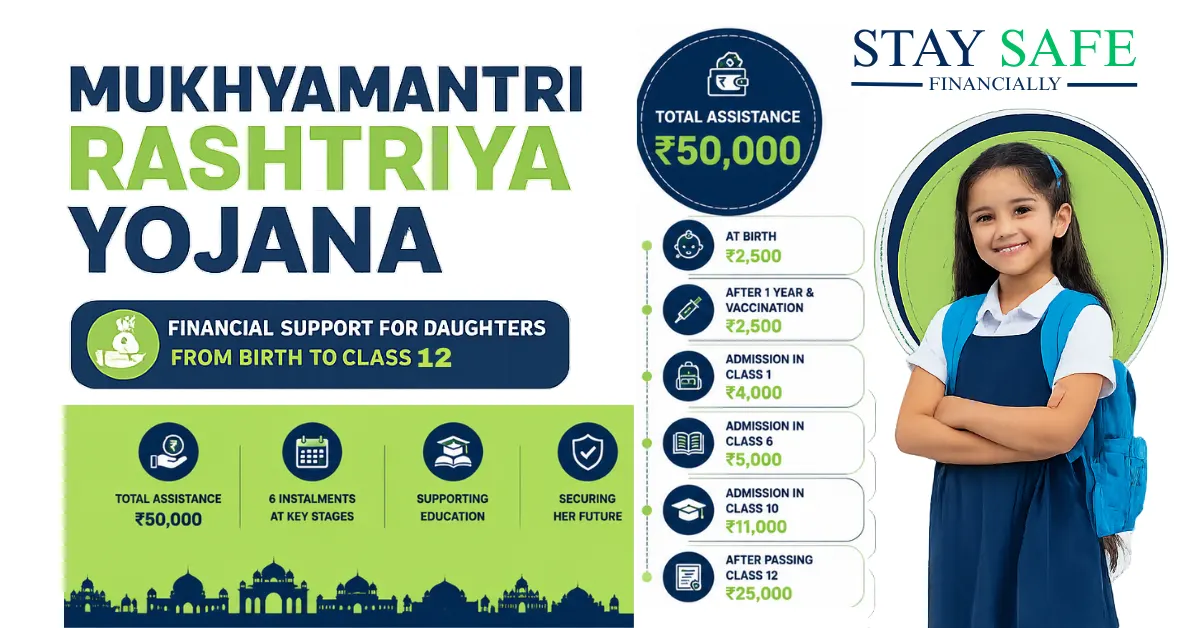
Mukhyamantri Rashtriya Yojana | मुख्यमंत्री राजश्री योजना

Mukhyamantri Rashtriya Yojana

Mukhyamantri Rashtriya Yojana provides ₹50,000 financial aid for daughters in Rajasthan from birth to Class 12. Know eligibility, instalments, and how to apply.

Why This Scheme Matters for Daughters

The government runs a scheme providing financial aid totaling ₹500 from the time of the daughter’s birth up to Class 12. However, the problem is that many people are unaware of this scheme, lack complete information, or fail to apply it correctly, thereby missing out on the benefits. Consequently, many families fail to avail themselves of this government financial assistance.

What the ‘Mukhyamantri Rashtriya Yojana‘ is, the amount of money provided, the Instalment structure, and who is eligible to benefit from it. We will also outline the entire application process and highlight the common mistakes that can cause the payment to be withheld.

What is Mukhyamantri Rashtriya Yojana?

First, let us understand what the ‘Mukhyamantri Rashtriya Yojana’ actually is.

Launch Date and Government Background

This is a highly significant Mukhyamantri Rashtriya Yojana implemented by the Government of Rajasthan. This scheme was launched during the tenure of the Vasundhara Raje government; it was initiated on June 1, 2016.

Main Objective of the Scheme

Its primary objective is to ensure that the birth of a daughter is not viewed as a burden. The Mukhyamantri Rashtriya Yojana aims to facilitate education for daughters, encourage the celebration of their birth, motivate them to move forward, and foster a positive mindset in society regarding daughters.

This excellent Mukhyamantri Rashtriya Yojana was launched with precisely this objective in mind. The government wants to ensure that no family views the birth of a daughter as a burden. To prevent any hardship, the government provides financial assistance from the time of the daughter’s birth until she completes the 12th grade.

Total Financial Assistance Under the Scheme

The total amount provided under the Mukhyamantri Rashtriya Yojana and address the key question on everyone’s mind: how exactly is this money received? We will explain the process and the disbursement details.

Is the Amount Paid in One Lump Sum?

Under this Mukhyamantri Rashtriya Yojana, the government provides a total of ₹5,000 in assistance. However, this amount is not paid as a lump sum; do not make the mistake of thinking that ₹5,000 is deposited into the daughter’s account immediately upon her birth. Instead, the money is disbursed in six separate instalments.

Instalment-Wise Payment Structure Explained

In this section, we explain each instalment in detail, outlining when it is released and how the amount is credited directly to the beneficiary’s bank account.

First Instalment – At the Time of Birth

The first instalment is released upon the daughter’s birth; the government provides ₹2,500 immediately after she is born. However, the government has stipulated a mandatory condition for this: the birth must take place in a government hospital or a registered private hospital, as proof of birth is required to process the first instalment.

Second Instalment – After One Year & Vaccination

The second instalment is released when the daughter turns one year old and has completed all her mandatory vaccinations. A key objective of this scheme is to ensure that daughters do not lag in any aspect, including healthcare; the second instalment also amounting to ₹2,500 is provided once the necessary vaccinations are completed.

Third Instalment – Admission in Class 1

Now, let us look at when the third instalment is released: it is provided when the daughter gets admitted to the first grade. In other words, you will receive an instalment when your daughter enters the first grade; the government currently provides ₹4,000 in assistance at this stage, which is a significant amount. The objective here is to encourage families to send their daughters to school, to motivate people to ensure their daughters attend school rather than remaining confined to household chores.

Fourth Instalment – Admission in Class 6

The fourth instalment, amounting to ₹5,000, is provided when the daughter enters the sixth grade; this ensures she faces no obstacles in her education and covers expenses such as notebooks, textbooks, and uniforms.

Fifth Instalment – Entry into Class 10

The fifth instalment is provided when the daughter enters Class 10; the government gives her ₹11,000 at this stage. This is done to ensure that girls do not drop out of school midway, as it is common in Rajasthan to see girls married off early, which often leads to them discontinuing their education.

Sixth Instalment – After Passing Class 12

The sixth and final instalment is a significant amount a substantial payout given when the daughter passes Class 12. This is crucial because the next phase is graduation, and she needs funds to secure her future. For this stage, the government provides a final instalment of ₹25,000.

Total Amount Received from Birth to Class 12

In total, combining all the instalments, the government provides financial assistance amounting to ₹50,000 a significant sum to help shape the daughter’s future.

Eligibility Criteria for Mukhyamantri Rashtriya Yojana

How you can receive this amount and who is eligible to benefit from it. An important question is: who can avail the benefits of this Mukhyamantri Rashtriya Yojana? There are specific conditions attached to the scheme; not everyone is eligible.

Residency Requirement

The first condition is that the daughter must be a resident of Rajasthan, as this is a scheme run by the Rajasthan government.

Date of Birth Condition

The second condition is that the daughter must have been born on or after June 1, 2016; if she was born before this date, she will not be eligible for the scheme.

Limit on Number of Daughters

The third condition is that the full benefits of the Mukhyamantri Rashtriya Yojana are available only to the first two daughters of the family; a third daughter would not receive the same level of benefit.

Documents Required for Application

Certain documents are also required for this process. If you wish to avail the benefits of this Mukhyamantri Rashtriya Yojana, you must have the necessary documents ready.

Mandatory Documents Checklist

 Which documents are required:

  • The girl’s birth certificate (as mentioned, the birth must have taken place in a hospital),
  • The parents’ Aadhaar cards, the Jan Aadhaar card.
  • A bank account (details of which must be provided).
  • Residence certificate to prove where you live.

Step-by-Step Application Process

Now, explain step-by-step how to apply for this Mukhyamantri Rashtriya Yojana. Understand each step thoroughly and follow the process exactly as described; do not make any mistakes.

Step 1 – Visit Jan Kalyan Portal

First, you need to visit the Rajasthan Government’s ‘Jan Kalyan Portal‘.

Step 2 to Step 5 – Form Filling, Upload & Verification

Step two: You will see an option for the ‘Rashtriya Yojana’

Step three: Click on that option and fill out the application form.

Step four: You must upload all the necessary documents.

Step five: After submitting the form, your application is sent for verification.

Just a quick note fill in the details and handle the documents very carefully to avoid any errors. Once verification is complete, the funds are transferred directly to your bank account; there is no need to run from pillar to post.

Common Reasons Why Payments Get Stuck

However, many people often ask why their payments get stalled. I am going to explain the reasons for this it is very important information, so please listen carefully if you plan to apply. The fact is, payments get held up for several reasons.

Birth Not Registered in Hospital

The first reason is that the girl’s birth is not registered at the hospital. As I mentioned earlier, this is crucial; the birth must take place in a hospital for you to receive the funds.

A adhaar Not Linked with Bank Account

The second reason is that the Aadhaar card is not linked to the bank account, which causes issues.

Vaccination Not Completed

The third reason is failing to complete the required vaccinations; this will cause your  instalment to be withheld. Consequently, many families miss out on the Mukhyamantri Rashtriya Yojana benefits and face difficulties. However, if you follow the steps and requirements I have outlined, you will receive the funds right up to the final  instalment.


CGHS explained: eligibility, benefits, free medical facilities, coverage, and hospitals. Complete guide to Central Government Health Scheme.

Income Tax Scrutiny Notice Section 143(2): Avoid Queries

Income Tax Scrutiny Notice Section 143

Income tax scrutiny Notice: Learn what to write in the Remarks section under Section 143(2) to avoid queries, penalties, and delays.

Section 143(2) Scrutiny Notice – Complete Guide for AY 2024-25

The Income Tax Department has started sending notices under Section 143(2) for previous years. If you or your client has received a scrutiny assessment notice under Section 143(2), I am going to explain the complete process in today’s session how to reply to it and what documentation is required. Hi guys, I am Vivek from FinTax Pro, where we discuss finance and taxation. Without further ado, let’s start today’s session.


What Is a Section 143(2) Notice?

let’s understand that you likely received two notices: one under Section 143(2) and another under Section 144B.

Difference Between Section 143(2) and Section 144B

The notice under Section 144B relates to ‘faceless assessment,’ while the one under Section 143(2) is for ‘scrutiny assessment’.

Now, what exactly is this assessment, and how does the process work? If you examine the Section 143(2) notice, it begins with, “Dear Taxpayer, Income tax scrutiny Notice the Income Tax Department appreciates your contribution to nation-building.


Assessment Year 2024-25 – Key Deadlines You Must Know

These notices have been issued for Assessment Year 2024-25.

Why Is the Income Tax Department Sending These Notices Now?

Why they are being sent now.

Last Date for Issuing Section 143(2) Notice

The deadline for issuing scrutiny assessment notices under Section 143(2) for Assessment Year 2024-25 is June 30, 2025. Since we are approaching the end of June, Income tax scrutiny Notice the Department is currently issuing a large number of these notices.

The notice acknowledges the care taken in preparing the income tax return but highlights certain issues requiring further clarification.


What Happens During a Scrutiny Assessment?

So, what happens during a scrutiny notice?

Meaning of Scrutiny Assessment Under Income Tax

The department scrutinizes your return, requests relevant documents, computes the tax liability, and conducts a scrutiny assessment. We will understand this entire process in detail, including the documents required. Accordingly, Income tax scrutiny Notice the income tax return has been selected for scrutiny assessment under the provisions of the Income Tax Act, 1961.

You may wonder why your return was selected. This is due to certain risk parameters, which will be explained shortly. Since the notice does not specify the reasons for issuance or the exact documents required, these aspects will be explained, along with guidance on how to submit a response through the portal and which documents need to be uploaded. The steps will be demonstrated during the session.

There is also a notice under Section 144B stating that your case has been assigned to the faceless assessment process. The key point is that you do not need to visit the Income Tax Department in person. Most income tax assessments are now conducted through the faceless assessment mechanism, except in cases such as search and seizure. Faceless assessment means the entire process is conducted online and is transparent. You will not know who is conducting the assessment, as all proceedings take place online.

This relates to your assessment. Questions such as why the notice was issued, what the risk parameters are, how to reply, and which documents to submit will be explained step by step in relation to ITR scrutiny under Section 143(2) for Assessment Year 2024-25.


How the Income Tax Return (ITR) Is Processed

First, you file your ITR. This could be a ‘Nil’ return (where no tax is due), a return with tax payable (where you have already paid the tax), or a return resulting in a refund. Income tax scrutiny Notice Once you file your ITR, it goes into the processing stage.

Role of CPC in ITR Processing

This processing is handled by the CPC (Centralized Processing Center) and is a completely automated, 100% online process. The system checks your documentation and ITR, extracting data from various sources.

Documents Used for Data Matching

These sources include Form 26AS, AIS (Annual Information Statement), TIS (Taxpayer Information Summary), and SFT (Statement of Financial Transactions) reporting; Income tax scrutiny Notice the data is cross-verified against these. After matching the data, an intimation under Section 143(1) is sent to you.


Section 143(1) vs Section 143(2) – Important Differences

I would like to clarify that the notice you received falls under Section 143. The Department conducts a scrutiny assessment under Section 143(2), whereas the communication under Section 143(1) is not technically called a ‘notice’ it is essentially an ‘intimation.’ It serves to inform you that the system has processed your ITR.

What Is an Intimation Under Section 143(1)?

So, an intimation is sent under Section 143(1), while a notice for scrutiny assessment is issued under Section 143(2). Therefore, if you have received a communication under Section 143(1), there is no need to panic. It is simply an intimation that every taxpayer who files an ITR receives a Section 143(1) intimation, which is a very routine matter.

What does it entail? If the CPC is satisfied with your ITR, there will be no outstanding dues. However, if there are issues regarding deductions or exemptions, or a mismatch in TDS, a tax demand might be raised, or if applicable a refund might be generated. Income tax scrutiny Notice Crucially, this is a 100% automated process; there is no manual intervention, as the entire procedure is handled by the CPC.


Risk Parameters That Trigger a Section 143(2) Notice

Moving on, let us consider the risk parameters factors that flag your ITR and increase the likelihood of receiving a notice.

Common Reasons for ITR Selection

I have listed a few examples here:

High-Value Transactions and Cash Deposits

high-value transactions appearing in your AIS (Annual Information Statement) that were not included in your ITR filing; significant cash deposits; Income tax scrutiny Notice a mismatch between your reported income and your GST turnover;

Income Mismatch With AIS, TIS, and Form 26AS

or discrepancies where the income reflected in your AIS, TIS (Taxpayer Information Summary), and Form 26AS differs from what you declared, effectively resulting in an under-reporting of income in your ITR.

High Refund Claims

An excessively high refund claim is a scenario you may encounter frequently now. Refund claims exceeding ₹2 lakh may attract closer Income tax scrutiny Notice and can result in your case being flagged for review.

The government has also become stricter regarding political party donations; if deductions under these sections are claimed, the likelihood of receiving a notice may increase. Other triggers include claiming exemptions or deductions in your ITR that are not reflected in Form 16. Income tax scrutiny Notice This is only an indicative list, as the Income Tax Department uses several other parameters to decide whether an ITR is selected for scrutiny.

Once the selection process begins, the department evaluates whether the case falls within specific risk parameters, including those mentioned above as well as others. If the case falls within these parameters, the department proceeds with further examination based on its internal assessment criteria.


Why Some Taxpayers Receive Notices While Others Don’t

You might wonder why you received a notice when a friend who did the same thing did not. The reason is that even if a case falls within risk parameters, the department applies additional selection filters and does not issue notices in every instance.

Based on approximately 1.65 lakh notices issued for Assessment Year (AY) 2024-25 against around 7 to 8 crore ITRs filed, the selection rate is less than 1%. Income tax scrutiny Notice This shows that scrutiny selection is a routine, periodic process rather than an indication that the department has suddenly become stricter.

The department selects certain ITRs each year based on defined risk parameters. In addition, its assessment may consider potential revenue impact. For example, between a case involving a refund of ₹2,000 and another involving ₹2.5 lakh, both flagged under similar risk parameters, the financial exposure is significantly higher in the latter case.

Department’s Financial Interest and Case Selection

Since the department has limited resources, they will prioritize the case where the financial impact is greater. In other words, they would prefer to scrutinize the case involving the ₹2.5 lakh refund rather than the one with the ₹2,000 refund. I cannot point to a specific document stating this rule, but these are the parameters that operate in the background.

Income tax scrutiny Notice Under the Faceless Assessment Scheme, all these aspects are examined, after which a notice is issued to you specifically, a notice under Section 143(2). Please note that the deadline for Section 143(2) notices for the Assessment Year 2024-25 is June 30, 2025. Regarding the types of assessments, there are three main categories you should be aware of.

Self-Assessment

The first is ‘Self-Assessment.’ What exactly is self-assessment? In India, both the GST and Income Tax systems operate on a self-assessment basis. You prepare your own tax computation and declare to the government: “This is my income, and this is the tax I am paying on it.” Income tax scrutiny Notice This constitutes self-assessment tax.

Income tax scrutiny Notice Essentially, when you file your Income Tax Return (ITR), it is done on a self-assessment basis meaning the taxpayer assesses their own tax liability; hence the term ‘self-assessment.’ Once the return is filed, the department reserves the right to scrutinize and verify it. When the department scrutinizes your return, two options arise: ‘Fair Judgment Assessment’ and ‘Best Judgment Assessment.’ Let me explain when each applies.

Fair Judgment (Regular) Assessment

A ‘Fair Judgment Assessment’ occurs when, for instance, you receive a notice and submit a reply (a process I will teach you shortly). You upload all relevant documents, computations, and information. Based on these, the department computes your tax liability and issues an assessment order. This process is known as ‘Fair Judgment Assessment’ or ‘Regular Assessment.’ Income tax scrutiny Notice This is also referred to as a scrutiny assessment. In this process, you submit all the required documents to the department; they conduct a full computation and subsequently issue an order. This is known as a regular assessment.

Best Judgment Assessment

However, situations often arise where a taxpayer receives such a notice but ignores it, failing to provide any reply. Even after the department sends a follow-up intimation, the taxpayer still does not respond. Ultimately, the department issues a ‘Best Judgment Assessment.’ Income tax scrutiny Notice Under this procedure, an order is passed and a tax demand raised based solely on the information available to the department.

Essentially, a Best Judgment Assessment is an *ex parte* order issued by the department; since you did not reply to the notice or provide any documentation, the department passes an assessment order based on its own best judgment. Now, let’s discuss the assessment procedure specifically, Income tax scrutiny Notice how it works and how you need to navigate the entire process (I will also demonstrate this on the portal).


Documents Required for Scrutiny Assessment

First, the taxpayer is required to submit certain documents. You might ask, “Which documents exactly?”

Mandatory Documents List

To begin with, you need to submit your detailed computation of income.

Bank Statements and Income Proof

Next, submit your bank statements.

Business Income Documents (PGBP)

Regarding the balance sheet, Profit & Loss (P&L) statement, and GST returns: if you have reported business income (PGBP), you must provide these documents as well. Income tax scrutiny Notice You will also need to submit Form 16 and pay slips specifically, pay slips covering the full 12-month period.

Capital Gains and Investment Proofs

Additionally, you must provide capital gains reports, including the “Tax P&L” statement from brokers like Zerodha or similar statements for equity shares from other brokers. You should also provide your home loan certificate. While no documents are required when filing an ITR under self-assessment, all these documents must be submitted as proof during a regular or scrutiny assessment. Only then will the department be satisfied and issue a fair assessment order.

If you hold a Fixed Deposit (FD), submit the FD statement so that interest income under “Income from Other Sources” can be verified. You may also submit income tax challans for taxes paid; although these details usually appear automatically in the system, providing them is beneficial. Income tax scrutiny Notice Regarding TDS and TCS certificates, these details are generally reflected in Form 26AS, but you should attach the certificates if available.


What If You Claimed Wrong or Fake Deductions?

If you claimed fake deductions or exemptions, you can rectify the situation by correcting your tax computation and submitting the revised figures.I will explain the applicable tax and penalty amounts and the payment process shortly.

However, a thought might cross your mind: “What if I create a fake rent receipt to justify the HRA deduction I claimed, even though I don’t actually pay any rent?” Look, there is a difference between a simple mistake and compounding that mistake. Income tax scrutiny Notice If you made an error by claiming a fake or bogus deduction in your ITR, that is one thing the department is now conducting an assessment, so you should simply rectify the error, pay the penalty, and settle any additional tax liability.

Why You Should Not Submit Fake Documents

If you compound the mistake, the consequences will be far more severe. Penalties can be heavy, and provisions for prosecution may even be invoked. Therefore, continuing with fraudulent practices such as submitting fake rent receipts or fabricated LIC receipts after an initial error is strongly discouraged.

Your documents will now undergo detailed verification, and third-party checks are possible; for example, the department may contact LIC to verify receipts issued against your PAN. Income tax scrutiny Notice It is advisable to avoid any further fraudulent activity. What is done is done, but at this stage you must prepare and submit a computation based on accurate reporting and actual documents.

After that, you submit the documents. Submitting documents does not mean the case is closed immediately; the department will verify them. This is a long-term process involving multiple stages. You submit a reply, the department raises further questions, seeks additional documents or explanations, and you must respond accordingly. Further clarification may be required, Income tax scrutiny Notice which you need to explain in detail. It is a lengthy process involving ongoing communication with the department, and it is entirely faceless, meaning all proceedings are handled online.


Final Assessment Order and Appeal Process

Finally, once the Assessing Officer is satisfied with all the documents, a final assessment order is passed. If everything is found to be in order meaning you claimed the correct deductions and exemptions there is no issue; no additional tax liability is added, and the case is closed.

When Penalty Is Imposed

But if the department perceives an issue, such as a problem with your documentation or a deduction you claimed but were not eligible for, the outcome can change. Income tax scrutiny Notice Sometimes taxpayers believe they are eligible for a deduction, but the interpretation under the Act may differ.

For example, taxpayers often assume that any tuition fee paid to a private coaching center for a child can be claimed under Section 80C. Income tax scrutiny Notice However, tuition fees eligible under Section 80C apply only to specific types of educational institutions. Income tax scrutiny Notice Payments made to private coaching centers cannot be claimed under this provision. Such claims may arise from misunderstanding or lack of awareness of the legal provisions rather than intent.

In such cases, the Income Tax Department will determine the correct tax liability and may impose a penalty. Since the department is conducting an assessment, a penalty may be levied, and additional tax may become payable.

If the taxpayer is not satisfied with the assessment order, they may choose to file an appeal against it. Let us now understand the appeals process.

Income Tax Appeal Hierarchy

The first appellate authority is the CIT(A) the Commissioner of Income Tax (Appeals). You would approach the CIT(A), who will pass an order, after which a specific hierarchy is followed. Income tax scrutiny Notice After the CIT(A), the next step is the ITAT (Income Tax Appellate Tribunal), followed by the High Court and the Supreme Court. The Supreme Court is the apex court, and its verdict is binding on everyone. That covers the entire appeals process.


Step-by-Step Process to Reply on Income Tax Portal

Now, let’s go straight to the Income Tax portal, and I will show you how to attach documents and submit a response. We are now on the Income Tax portal; first, please log in to your account.

How to Download the Notice

After logging in, you need to go to ‘Pending Actions,’ where you will find ‘e-Proceedings.’ Navigate to the ‘e-Proceedings’ section. Income tax scrutiny Notice There, you will see notices for the Assessment Year 2024-25; click on ‘View Notices.’ You will see two notices here. If you download the notice letter PDF, the notices I showed you earlier will be downloaded.

How to Request an Adjournment

There is another option I would like to discuss: the option to view or request an adjournment. Sometimes, you may need to reply to a notice in this case, the deadline is July 8th but gathering all the necessary documents and information might take a bit longer. Income tax scrutiny Notice This is where the adjournment option becomes very important; you can click here to request more time.

You must provide a valid reason to the department for seeking the adjournment such as the time required for documentation or the preparation of specific records like balance sheets or P&L statements (even if finalized, extracting the data or trial balances takes time). Income tax scrutiny Notice In my experience, adjournments are generally granted. So, if you need more time to gather documents, collect information, or prepare the tax computation, you can opt for an adjournment.

How to Submit Response and Upload Documents

Now, let’s move on to a crucial step: submitting the response. Let me explain what needs to be submitted. First, click on “Submit Response.” Before proceeding, please read the provided information. You can upload PDF, Excel, and CSV files here. Income tax scrutiny Notice Ensure that any documents you upload are crystal clear and legible, clearly showing the information required for a proper assessment. Click “Continue,” and you will be presented with the option to submit your response.

As I mentioned earlier, simply submitting a response doesn’t mean the entire process is over. You will submit a response and attach the necessary documents, after which your assessment will take place; you may be asked questions or required to provide explanations that is the subsequent stage. Income tax scrutiny Notice For now, the immediate first step is to attach the documents here.

What to Write in the Remarks Section

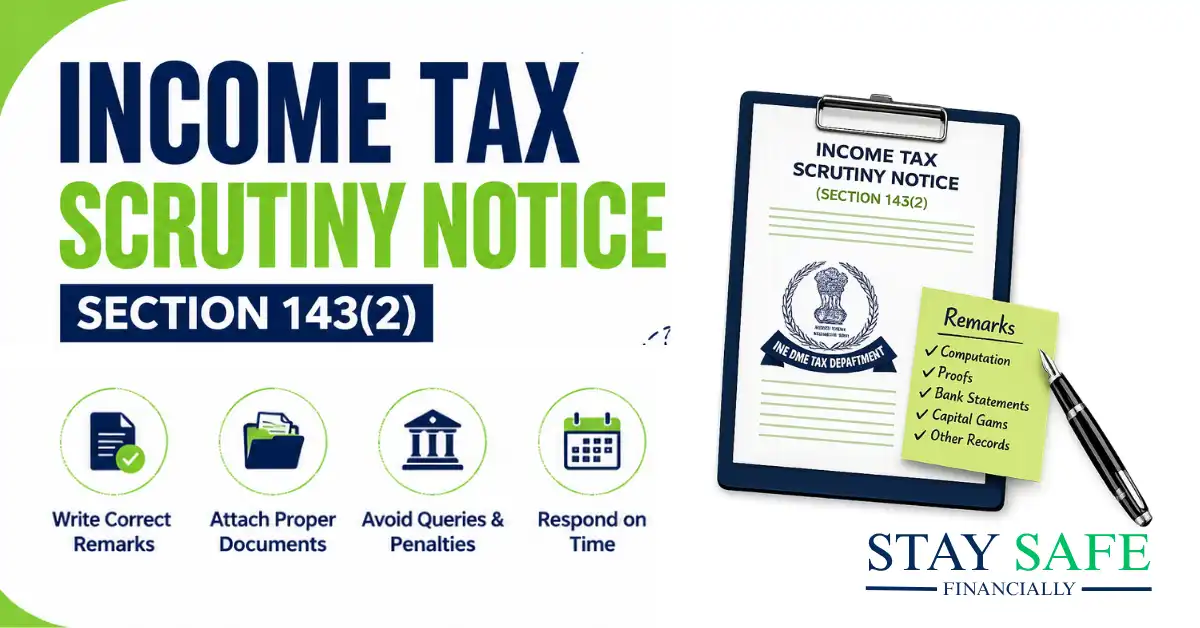
Income tax scrutiny Notice You might ask, “What should I write in the ‘Remarks’ section?” In the remarks, you should state that the detailed computation for Assessment Year 2024-25 along with proofs of income, exemptions, deductions, bank statements, capital gains statements, and other applicable records are being attached for assessment. This indicates that you are submitting all relevant documents for the assessment process.

Attaching documents is crucial because the department is conducting your assessment. Bank statements are mandatory. If you do not attach documents now, the department will ask for them later through a questionnaire. Providing detailed information upfront reduces follow-up questions. Income tax scrutiny Notice Withholding information, such as attaching only the computation without supporting documents, creates issues because the income figures must be substantiated.

If you are reporting income under “Profits and Gains of Business or Profession” (PGBP), you must attach the Balance Sheet and P&L statement. Income from “Other Sources,” such as interest, must be verified against your savings bank statement, so that should also be attached. Income tax scrutiny Notice Choose the appropriate document type, such as bank statements or transaction statements. Demat account statements can be uploaded under the transaction statement category.

If a required document is not listed, use the “Others” category and add one or more documents using the “Add Document” button. You may also attach a cash flow statement or any other relevant information, mentioning it accordingly. Attach all supporting proofs along with the computation, then click “Continue” and submit.


Section 144B Faceless Assessment – How to Respond

Now, the question arises: what is covered by Section 143(2), but what about the response required under Section 144B? Let me explain that as well. Income tax scrutiny Notice Here is where you submit the response for Section 144B. You do not need to re-attach all the documents here; you can simply mention the details within the ‘Full Response’ section.

Difference Between Partial and Full Response

There is also an option for a “Partial Response.” If you do not have all the information available at once and wish to upload documents in multiple stages, you can select the “Partial Response” option. For example, if you have uploaded the bank statement and income tax computation but plan to attach the P&L statement and balance sheet later, you can submit a partial response now.

However, ensure that you submit the “Full Response” before the reply deadline expires. Even after submitting a partial response, you can add further documents. Income tax scrutiny Notice Once you submit the “Full Response,” you will not be able to reply further to this notice unless the Department requests additional information or raises further queries.

Under Section 144B, you can mention that all documents required for the computation related to the Section 143(2) notice have already been provided and simply refer to that. Income tax scrutiny Notice Alternatively, if you wish, you may re-upload the same documents, though it is not strictly necessary. The required information has already been provided, and the computation will be processed. Essentially, the Section 144B communication informs you that your case has been assigned to the faceless assessment process, which is why this information is requested.


Q1. What is an Income Tax Scrutiny Notice under Section 143(2)?

An Income Tax Scrutiny Notice under Section 143(2) is issued when the Income Tax Department wants to verify the correctness of your filed ITR by examining documents and explanations.

Q2. Is receiving an Income Tax Scrutiny Notice a serious issue?

No. It is a routine process. It does not mean wrongdoing. It only means the department wants clarification or supporting documents for certain details in your return.

Q3. What should I write in the Remarks section while replying to a scrutiny notice?

In the Remarks section, you should mention that you are submitting the detailed computation of income along with supporting documents such as bank statements, deductions, and income proofs for assessment.

Q4. Which documents are mandatory for replying to a scrutiny notice?

Mandatory documents generally include bank statements, income computation, Form 16, capital gains statements, business P&L and balance sheet (if applicable), and proof of deductions claimed.

Q5. What happens if I do not reply to an Income Tax Scrutiny Notice?

If you fail to reply, the department may pass a Best Judgment Assessment, which can result in higher tax demand, penalties, and interest without considering your explanations.


Explore the most important government-funded student grantseducation subsidy programs, and student aid schemes available in 2025.

Fixed Deposit Interest Rates | Best Banks For FD 2026

Best Banks For FD

Best Banks For FD in 2026 compared. Check FD interest rates of public, private & small finance banks and learn how smart tenure choices can earn up to 8% Best Banks For FD.

Table of Contents

Overview of Banks Offering Best Banks For FD in India

There are a total of 12 public sector banks, 21 private sector banks, and 11 small finance banks in our country. There are also six payment banks Best Banks For FD.


Fixed Deposit Interest Rates of Public Sector Banks

So, let’s begin with public sector banks Best Banks For FD.

Highest FD Interest Rate Among Public Sector Banks

Among them, Punjab & Sind Bank is currently offering the highest interest rate. If you open a one-year Best Banks For FD with Punjab & Sind Bank, you get an interest rate of 5.85%.

Why One-Year Fixed Deposits May Not Be the Best Choice

Best Banks For FD However, you might not necessarily want to opt for a one-year FD. Many people simply visit a bank or open an app and immediately book a one-year FD.

Example – Punjab & Sind Bank 444-Day FD vs 1-Year FD

Let’s say you open a one-year Fixed Deposit (FD) with Punjab & Sind Bank; you would get an interest rate of 5.85%. However, instead of a standard one-year FD, if you opt for a 444-day FD which is one year and 79 days you get an interest rate of 6.80%.

Essentially, by extending the FD duration by just 79 days, your interest rate rises from 5.85% to 6.80%. Here is how I have laid this out: on this side, I have listed the interest rates offered by various banks for a standard one-year FD. On the other side, I have noted the tenure that offers the best interest rate for that specific bank.

Example – Bank of Baroda FD Tenure Comparison

Take Bank of Baroda as another example: it offers 6.25% interest on a one-year FD, but if you choose a 444-day FD (one year and 79 days) instead, you get 6.45%, which is their best rate.

Example – Bank of Baroda FD Tenure Comparison

Through every single one individually; you can take a screenshot of this and review it at your leisure. Check the interest rates offered by the bank where you hold an account. For instance, if you have an account with the Bank of Maharashtra, the interest Best Banks For FD rates are quite low; the rate for a one-year FD is 6.20%, which is also their best rate. It took me an entire day to visit each bank’s website and compile these figures.

Latest FD Interest Rates Update (June 2026)

Best Banks For FD These are the latest interest rates as of June 2026. The data presented here reflects the latest rates for June 2026. Is that clear?.


Fixed Deposit Interest Rates of Private Sector Banks

Now, let’s about private sector banks.

Private Bank Offering the Highest FD Interest Rate

Best Banks For FD Among them, Best Banks For FD Bandhan Bank offers the highest interest rates; the rate is 7% for a one-year FD and 7.25% for a two-year FD.

FD Interest Rates of Major Private Banks

Major banks like HDFC, ICICI, and Axis all offer 6.25% on one-year FDs.

Best FD Tenure for HDFC, ICICI, and Axis Bank

HDFC Bank offers its best rate 6.5% on a tenure of 3 years and 1 day. Similarly, ICICI Bank also offers 6.5% for a tenure of 3 years and 1 day, while Axis Best Banks For FD Bank offers its best rate of 6.45% for a 15-month FD.


Fixed Deposits in Small Finance Banks

Now, Small Finance Banks Best Banks For FD.

Are Small Finance Banks Safe for Fixed Deposits?

The first question that arises is: are Small Finance Banks safe? Yes, they are. All 11 Small Finance Banks in India are safe. They are all insured by the DICGC.

What Is DICGC and How Deposit Insurance Works

What is the DICGC? It stands for Deposit Insurance and Credit Guarantee Corporation. It is a subsidiary of the RBI. This body the DICGC provides Best Banks For FD protection to every bank in India. Best Banks For FD What kind of protection? It guarantees that if a bank were to fail, the customers’ deposits would be protected up to a certain limit.

Example of ₹5 Lakh DICGC Insurance Limit

Let’s assume you have money in a bank I won’t name the specific bank. Suppose you had a Fixed Deposit (FD) of ₹2 lakh, ₹1 lakh in a savings account, and ₹4 lakh in a current account with that bank. Best Banks For FD That makes a total of ₹7 lakh (2 + 1 + 4). If God forbid that bank were to fail, the DICGC steps in.

It states that if the bank is insured by the DICGC, it guarantees coverage of up to ₹5 lakh per customer. So, in your case, since you had ₹7 lakh, the DICGC would pay you ₹5 lakh, and you would have to bear a loss of ₹2 lakh.

However, if you had a total of only ₹3 lakh, the DICGC would have paid the entire ₹3 lakh, provided the bank was insured by them. Are all Small Finance Banks in India insured by the DICGC? Yes, all 11 of them are insured by the DICGC.

Safe FD Investment Limit in Small Finance Banks

If you are opening a Fixed Deposit (FD) with a small finance bank, try not to invest more than ₹5 lakh. Do you get the point? It’s about playing it safe. It’s a simple concept.

Highest FD Interest Rate Offered by Small Finance Banks

Right now, J Small Finance Bank is offering the highest interest rates. If you open a one-year FD, you get 7%.

How FD Tenure Can Increase Interest Rate Dramatically

If someone blindly opens a one-year FD with J Small Finance Bank, they get 7%, but if they opt for an FD of one year and one day, the rate jumps to 7.5%. Now, Best Banks For FD ask yourself why do banks do this? They do it so customers will simply walk in and open a one-year FD without a second thought.

Otherwise, it feels a bit like a scam like they are taking advantage of the customer. They could easily have kept the interest rate the same say, 7.5% regardless of whether the term was one year or one year and one day, right? But the customer doesn’t know this; they come in, open a one-year FD, and lose out on half a percent. And consider this interesting detail: a one-year FD offers 7%, while a one-year-and-one-day FD offers 7.5%.

Example – 370-Day FD vs 1-Year FD Interest Difference

What is the difference in days? A year has 365 days; a year and a day has 366. If you extend the term by just four more days making it a 370-day FD the interest rate becomes 8.11%. Just imagine someone with an account at this bank locking in a one-year FD at 7% Best Banks For FD when they could have easily opted for a 370-day term at 8.11% by adding just a few extra days.

Example – Utkarsh Small Finance Bank FD Rates

For instance, look at Utkarsh Small Finance Bank: the best interest rate is 6% for a one-year FD, but it goes up to 8.10% for a 666-day FD (which is roughly one year and ten months).


Which Banks Offer the Highest FD Interest?

Now, did you notice something here?

Ranking of Banks Based on FD Interest Rates

Observe that Small Finance Banks offer the highest interest rates. Private banks come in second, and government banks offer the lowest rates. Best Banks For FD Yes, there might be the occasional exception, but generally speaking, Small Finance Banks offer the highest interest, followed by private banks, with government banks offering the lowest.

Why Government and Large Private Banks Offer Lower FD Rates

Why is that? One more thing let me pull up the list for private banks. Even among private banks, major players like HDFC, ICICI, and Axis Bank had the lowest interest rates. Right? We saw that earlier.


Safety vs Returns – Choosing the Right Bank for FD

Now, consider this simple point: which are the safest private banks? Names that immediately come to mind today are ICICI Bank, Axis Bank, HDFC Bank, and Kotak Mahindra Bank. Best Banks For FD These are the four or five names we trust implicitly, knowing they aren’t going anywhere.

Why People Prefer Government Banks Despite Lower Interest

All twelve of them are 100% safe because they have government backing. Fair enough? And the thing with SAL Finance Bank is even though they are offering an interest rate of 8.11% people still don’t open Fixed Deposits (FDs) with them.

What is the reason? people are apprehensive about banks like Small Finance Banks. If I were to ask my father today, “Would you open an FD with a Small Finance Bank? They are offering an interest rate of 8.11%,” he would simply say, “I’d rather keep the money at home than open an FD with such a bank.

” Why? Even though they are safe and who is going to explain to him that they are insured by the DICGC? his instinct would be to refuse. He would say, “I’ll put it in SBI.” He has an account with the Post Office; in fact, he doesn’t even prefer private banks. All his accounts are with government banks.

Supply and Demand Logic Behind FD Interest Rates

Also, FD interest rates depend on supply and demand. Take SBI, for instance why would they drastically raise their FD interest rates? You see? Now, look at a Small Finance Bank; it might be offering 8.11% on FDs today. Why? Because they aren’t exactly flooded with FD deposits.

It’s like baiting a fish banks do the same thing. A Small Finance Bank offers attractive rates to lure in as many FD deposits as possible. On the other hand, consider SBI the country’s largest bank. Best Banks For FD It already has a vast customer base ready to open FDs; it doesn’t need to go out of its way to attract anyone. Similarly, banks like ICICI, HDFC, and Axis automatically receive plenty of FD deposits, so they don’t need to offer highly attractive interest rates either.

Do you understand? If you were to open an FD, you would naturally look for a safe bank. We know that government banks are safe you can open an account with any of them, and your money is secure. Naturally, public sector banks already hold a vast volume of fixed deposits (FDs).

Best Banks For FD We know that banks like ICICI, HDFC, and Axis are secure being private banks, they already command a large share of deposits, so they don’t feel the need to offer exceptionally high interest rates.

Do you see the point? However, if you *do* wish to open an FD with a Small Finance Bank, you certainly can; just try not to exceed the ₹5 lakh limit. That is the threshold I would recommend. Up to ₹5 lakhs, you have protection from an RBI subsidiary, so there is really nothing to worry about.


Final FD Comparison Across All Banks

Now, let’s compare all the banks Small Finance Banks, private banks, and public sector banks to see the results. Here is the list: at the very top, we see Small Finance Banks dominating one after another. Best Banks For FDThen comes the first private bank, Bandhan Bank, followed by a series of other private banks.

IndusInd is also in that private bank category. The first public sector bank to appear is Punjab & Sind Bank, offering an interest rate of 6.80%.

Best FD Options Based on Risk Appetite

So, if you want to play it extremely safe deciding against Small Finance Banks entirely Punjab & Sind Bank is your best option. If you are willing to take a slight risk, the highest-paying private sector bank is Bandhan Bank, offering an interest rate of 7.25%. Alright? You can also proceed in this manner.


Fixed Deposits vs Mutual Funds – Risk Appetite Matters

There is one more thing. “Who would invest in an FD? You should invest all your money in mutual funds.” They argue that mutual funds offer returns of around 12%, whereas FDs offer very little, Best Banks For FD so one should just put everything into mutual funds. But look, the game isn’t the same for everyone has a different risk appetite.

Why Fixed Deposits Are Still Relevant for Senior Citizens

The money he has is his life savings his final nest egg. He is retired now and doesn’t have a regular income. At 65, he simply cannot afford the risk of putting his money into mutual funds. Best Banks For FD And that is exactly how he has managed his finances: he has invested some money in the MIS scheme and some in the Senior Citizen Savings Scheme.

He hasn’t opted for an SWP (Systematic Withdrawal Plan) or invested in mutual funds. Even if I were to suggest, “Invest in mutual funds and set up an SWP; you’ll get better returns than the MIS or Senior Citizen Savings Scheme,” he would give a flat “no” he simply doesn’t want to invest that way.

Why? Because his risk appetite is zero. So, you can’t tell everyone to put their money into mutual funds; everyone’s risk appetite differs. For many people, FDs are the right choice. Best Banks For FD Do you see the point? Yes. Now, if you want to invest in mutual funds, go ahead there’s no issue with that.

Importance of Diversification in Personal Finance

But if you are saving ₹100, you wouldn’t just invest the entire ₹100 into mutual funds, right? You need to diversify. Put some money into mutual funds, some into FDs, and some into debt funds. Best Banks For FD Also, allocate some funds to government schemes like the PPF (Public Provident Fund), for instance. Do you get the point? You need to diversify in this manner.


1. Which are the Best Banks For FD in India in 2026?

The Best Banks For FD in 2026 include select Small Finance Banks offering up to 8% interest, followed by private banks like Bandhan Bank, while public sector banks offer lower but safer returns.


2. Is it safe to invest in Fixed Deposits of Small Finance Banks?

Yes, Small Finance Bank FDs are safe up to ₹5 lakh per depositor per bank, as they are insured by DICGC, a subsidiary of the RBI.


3. Why do FD interest rates differ for 1 year and special tenures like 444 or 666 days?

Banks offer higher rates on specific tenures to attract deposits. Choosing these special FD tenures instead of a standard 1-year FD can significantly increase returns.


4. Which bank gives the highest FD interest rate currently?

As of June 2026, some Small Finance Banks offer the highest FD interest rates, going beyond 8% for select tenures, higher than most private and public banks.


5. Are Fixed Deposits better than mutual funds for senior citizens?

For senior citizens with low risk appetite, Fixed Deposits are often better than mutual funds because they provide capital safety, guaranteed returns, and regular income.


The best credit cards in India for cashback, travel, fuel, and lifetime-free benefits. Compare fees, rewards, and pick the right card.

Is LIC Navjeevan Shree Better Than FD?

LIC Navjeevan Shree Better Than FD?

LIC Navjeevan Shree Plan 911 benefits, returns, maturity value, death cover, surrender value, loan facility, and tax benefits in detail

What Is LIC Navjeevan Shree Single Premium Policy?

The LIC fixed deposit plan I’m discussing is the ‘Navjeevan Shri’ (Plan No. 911). It is a single-premium life insurance plan, meaning you pay the premium just once and receive life cover, bonuses, and tax benefits.

This plan is designed for those who want to invest like an FD but desire higher returns. You get better benefits here compared to a standard bank FD specifically the life cover.

Why LIC Navjeevan Shree Is Better Than a Bank FD

Unlike a bank FD, which doesn’t offer life cover, this LIC plan provides substantial life cover. For instance, if you invest ₹1 lakh, you could get a cover of at least ₹1 lakh. I will explain all these details further in the video, so please make sure to watch it in its entirety.

Key Features of LIC Navjeevan Shree Policy

Non-Participating and Non-Linked Nature

LIC Navjeevan Shree plan is a non-participating policy. It is crucial to understand this term; whenever you purchase any policy, grasping these small details is essential.

Meaning of Non-Participating Policy

Non-participating means that regardless of whether LIC Navjeevan Shree makes a profit or a loss, you will receive your returns. You will get exactly what is stated on the bond paper not a reduced amount, but the full return promised, whether LIC incurs a loss or makes a profit.

Meaning of Non-Linked Policy

The “non-linked” aspect. This LIC Navjeevan Shree plan is non-linked, meaning the premium amount you deposit will not be invested by LIC in the share market or stock market. Consequently, your money remains safe and completely secure.

Single Premium Investment and Guaranteed Additions

Single premium means the premium is paid just once.

Guaranteed Bonus of ₹85 per ₹1,000 Sum Assured

This is a single-premium savings endowment plan featuring a guaranteed addition of ₹85 per ₹1,000 of the Sum Assured. Essentially, for every ₹1,000 of the Sum Assured, you receive a guaranteed bonus of ₹85. For instance, if you pay a single premium of ₹1 lakh, you will earn a bonus of ₹8,500 in a year, which will be added to your maturity payout.

Policy Term and Eligibility Criteria

You can invest in this LIC Navjeevan Shree plan for a tenure ranging from a minimum of 5 years to a maximum of 20 years. The longer you invest, the greater the returns and benefits you will receive.

Minimum and Maximum Entry Age

There is also an age limit for investing in this LIC Navjeevan Shree plan; the minimum age requirement is 30 days. You can invest in this LIC plan in the name of your children. The maximum entry age limit is 60 years for Option 1 and 40 years for Option 2.

Policy Options Explained (Option 1 vs Option 2)

It is crucial to understand this aspect: when you read about or purchase this policy, you will have to select one of the two options Option 1 or Option 2. Understanding both options is very important. Let’s look at what they entail. The death benefit that is, what the nominee receives upon the policyholder’s death depends on the option you choose.

Death Benefit Under Option 1

Under Option 1, the payout is either 1.25 times the premium paid or the sum assured (the policy amount), whichever is higher.

Under Option 2, the payout is 10 times the premium paid; for instance, if you have paid a premium of ₹1 lakh, your nominee would receive at least ₹1 lakh. Therefore, you should select Option 2 if you decide to purchase the policy. In this video, I will base all further calculations on Option 2, as it offers the greatest benefit.

Minimum and Maximum Investment Amount

You can purchase an LIC Navjeevan Shree FD plan with a minimum investment of ₹1 lakh; there is no upper limit. You can invest amounts like ₹1 lakh, ₹5 lakh, ₹10 lakh, or even more it all depends on your budget, financial goals, and how much you wish to invest.

Surrender and Loan Facility in LIC Navjeevan Shree

You also have the option to surrender the LIC FD plan if the need arises; you can surrender the policy at any time after purchasing it.

Loan Against Policy

Similarly, you can take a loan against the LIC FD plan if required. You can avail of a loan anytime after three months of purchasing the policy. I have detailed the loan amount and the associated calculations later in the video.

Tax Benefits of LIC Navjeevan Shree Policy

LIC Navjeevan Shree FD plan also offers significant tax benefits. The premiums you pay qualify for benefits under Section 80C, and the maturity amount you receive is entirely tax-free under Section 10(10D).

Now, let’s discuss the maturity amount you receive based on the premium paid. I will also explain what the nominee receives in the event of death. Let’s look at the potential surrender value and loan amount.

Example Calculation – ₹1 Lakh Investment

Suppose you are 25 years old and invest in an LIC Navjeevan Shree endowment plan for a term of 20 years. If you opt for a Sum Assured of ₹1 lakh, the total premium payable would be ₹17,000 comprising a base premium of ₹12,400 and ₹4,600 in taxes.

At maturity, you would receive the Sum Assured of ₹1 lakh. Additionally, considering the bonus of ₹85 per ₹1,000 of Sum Assured awarded annually, you would accumulate ₹1,70,000 in bonuses over the 20-year period.

Maturity Amount After 20 Years

Consequently, the total maturity value after 20 years would be ₹2,70,000. You invested approximately ₹1 lakh and are receiving ₹2,70,000 at maturity. However, do not look solely at the financial return; consider the risk cover as well specifically, the 10 times risk cover, which I will explain now.

Death Benefit, Surrender Value, and Loan Illustration

For instance, if the policyholder who took a policy with a Sum Assured of ₹1 lakh and paid a total premium of ₹17,000 passes away at the age of 26, their nominee would receive ₹1,01,400.

If the policy is surrendered at age 26, the payout is ₹81,000, and a loan of approximately ₹400 is available.

If the policyholder passes away at age 30, the nominee receives ₹1,74,000; if the policyholder chooses to surrender at age 30, they receive ₹11,000, or they can avail a loan of ₹72,000.

If the policyholder passes away at age 35, the nominee receives ₹11,16,000; surrendering at age 35 yields ₹1,32,000, while a loan of ₹93,000 is available.

If the policyholder passes away at age 40, the nominee receives approximately ₹11,600; surrendering at age 40 yields ₹1,64,000, and a loan of ₹1,15,000 is available.

If the policyholder passes away at age 44, the nominee receives approximately ₹11,94,000; surrendering at age 44 yields a value of ₹9,000, and a loan of approximately ₹1,46,000 is available.

₹2 Lakh Investment – Maturity, Death & Surrender Details

Now, regarding a policy with a sum assured of ₹2 lakh: the premium payable is ₹2,05,000, comprising a base premium of ₹1,96,000 and tax of ₹8,800.

Including all bonuses, the total maturity payout amounts to ₹5,400.

The total premium deposited is approximately ₹2 lakh. Beyond this, you must also consider the risk cover provided. In other words, if the policyholder passes away before maturity, what will the nominee receive? This feature is not available with standard Fixed Deposits (FDs) whether at a post office or a bank.


Discover the 5 common mistakes in life insurance people make when buying life insurance. Learn what to avoid and protect your family’s future.

Best Credit Cards In India | Top 10 Cards for Cashback

Best Credit Cards In India

The best credit cards in India for cashback, travel, fuel, and lifetime-free benefits. Compare fees, rewards, and pick the right card.


Best Cashback Credit Cards in India

Among the best cashback Best Credit Cards, we will first two specific cards: the Axis Bank Cashback Credit Card and the State Bank of India (SBI) Cashback Credit Card.

Table of Contents

SBI Cashback Credit Card – Features, Fees & Cashback Structure

Best Credit Cards, Regarding the SBI Cashback Credit Card, understand that its features have been devalued a few times; in fact, they have been significantly devalued. Yet, I would still say it remains the best credit card in the cashback category.

SBI Cashback Card Fees Explained (Including GST)

SBI Cashback Card Cashback Rates & Monthly Caps

So the fee is ₹999. What do you get in return? This card offers 5% cashback on any online spending. For any offline spending, you will get 1% cashback.

As for online spending, whether on Amazon, Flipkart, Swiggy, Zomato, or anywhere else, you get 5% cashback, but there is a monthly cap of ₹2,000. Essentially, you could say that spending ₹40,000 in a month allows you to avail the maximum cashback.

Why? Because 5% of ₹40,000 is ₹2,000. Do you get the point? Best Credit Cards, Similarly, for offline spending, you get 1% cashback, capped at ₹2,000 per month. These are the key features of the SBI Cashback Credit Card.

Axis Bank Cashback Credit Card – Is the 7% Cashback Claim True?

The Axis Bank Cashback Credit Card. Many people made videos claiming that a new card, the Axis Bank Cashback Credit Card, had arrived to surpass the SBI Cashback card in the cashback category. best credit cards Why? Because the SBI Cashback Credit Card offers 5%, right? So, they started advertising 7% for this one.

Axis Cashback Card Fees & Annual Charges

The fees are similar, Best Credit Cards, too while the SBI card costs ₹999, this one costs ₹1,000; both the joining fee and the annual fee are ₹1,000. Also, the annual fee applies right from the first year.

Axis Cashback Tiered Cashback Structure Explained

It actually offer 7% cashback? No. Its features are quite similar to the SBI Cashback card, but it doesn’t offer a flat 7%. Instead, the structure is based on your monthly spending: for the first ₹5,000 spent online during the month, you get 2% cashback.

For any spending beyond that, specifically between ₹5,000 and ₹40,000, you get 5% cashback. You will receive 7% cashback on any spending above ₹400. With the SBI Cashback Credit Card, the maximum monthly cashback was ₹2,000, whereas the Axis Cashback Credit Card offers a maximum monthly cashback of ₹4,000.

SBI vs Axis Cashback Credit Card – Which One Should You Choose?

If your monthly spending is less than ₹400, you should go for the SBI Cashback Credit Card without a second thought. However, if you have high online spending where your expenses frequently exceed ₹400, then you can confidently opt for the Axis Cashback Credit Card. Best Credit Cards, That is essentially the distinction between these two cards.

HDFC Swiggy Black Credit Card – Best Card for Swiggy Users

The card in the cashback category is the HDFC SWGI Black Credit Card. Speaking of HDFC SWGI credit cards, the range includes both the Orange Credit Card and the HDFC SWGI Black Credit Card.

Swiggy Black Card Cashback Benefits & Limits

This card has a joining fee of ₹1,000 and an annual fee of ₹1,000. But how does it differ from the SBI Cashback and Axis Cashback credit cards?

This card offers 10% cashback on any spending within the Swiggy app, whether you order food, use Swiggy Dineout, or use the Swiggy Instamart option. Best Credit Cards, You get 10% cashback on absolutely everything spent on Swiggy.

Additionally, it offers 5% cashback on online spending, with a monthly cap of ₹1,500. It also provides 1% cashback on offline spending, capped at ₹1,000 per month.

So, in terms of cashback categories, it is quite similar to the SBI and Axis Cashback cards; the key difference is the tie-up with Swiggy, Best Credit Cards, which allows you to earn that 10% cashback on Swiggy-related expenses.

HDFC Tata Neu Infinity Credit Card – Best RuPay Cashback Card

Next up is the HDFC Tata Neu Infinity credit card. You could consider this ‘Infinity’ card one of the best in the cashback category, as well as one of the best among RuPay credit cards.

Tata Neu App Cashback & UPI Rewards

What does it offer? Well, this card states that its fees are slightly higher; it doesn’t charge just ₹1,000; instead, both the joining fee and the annual fee are ₹1,499. In return, this credit card offers a benefit: if you make any purchases via the Tata Neu app, you get 10% cashback.

Essentially, the Tata Neu app already provides 5% cashback to every user, and you receive an additional 5% by using this credit card, bringing the total cashback to 10%. Whether you order clothes, shoes, or groceries like lentils, flour, and rice, covering all Tata products as well as items from other brands (making the app similar to Amazon or Flipkart), you earn 10% cashback on any expenditure.

Furthermore, the app allows you to link this credit card and use the “Scan and Pay” feature directly within the Tata Neu platform. Best Credit Cards, It offers 1.5% cashback on every UPI transaction made by scanning and paying with this credit card. You can earn a maximum of ₹500 in cashback per month. Additionally, you get 10% cashback on the Tata Neu app and 1.5% cashback on every UPI transaction.

Airport Lounge Access & Premium Benefits

Apart from this, it provides access to domestic airport lounges eight times a year and international airport lounges four times a year. This credit card is named the HDFC Tata Neu Infinity Credit Card.

SBI PhonePe Select Black Credit Card – Benefits After Devaluation

SBI PhonePe Select Black Credit Card, which is a result of a partnership between SBI and PhonePe. It has a joining fee of ₹1,499 and an annual fee of ₹1,499.

PhonePe Cashback Structure & Monthly Caps

What features does it offer in return? If you use this credit card to make any expenditure on the PhonePe app, whether it’s a mobile recharge, bill payment, insurance premium, or anything else, you get an immediate 10% cashback.

As the card gained popularity, Best Credit Cards, people started using it heavily to pay insurance premiums, thinking, “If we pay the premium, we’ll get 10% cashback.

SBI PhonePe Card Devaluation Explained (Effective July 1)

Best Credit Cards, However, the benefits were subsequently devalued. SBI has announced changes effective July 1, 2026. Previously, the feature offered 10% cashback on any spending via PhonePe, subject to a monthly cap of ₹2,000. So, you would get 10% cashback on PhonePe transactions, up to a maximum of ₹2,000 per month.

Starting July 1, 2026, the condition is that the maximum cashback for insurance payments will be ₹500, while the maximum cashback for other PhonePe features will be ₹1,500. You still get a total of ₹2,000 in cashback on PhonePe; it has simply been bifurcated.

Another feature was that if you made any online purchases using this credit card, you would receive 5% cashback. Previously, the maximum monthly cashback for this was ₹2,000, but it has now been reduced to ₹1,000. See? Best Credit Cards, So, this represents a devaluation effective from July 1, 2026. Best Credit Cards, Additionally, it offers four domestic airport lounge access visits per year and two international airport lounge access visits per year.

The Airtel Axis Bank Credit Card. You could say this used to be an excellent card in the cashback category. Why? It offered 25% cashback on mobile, broadband, and Wi-Fi recharges made through the Airtel Thanks app, 10% on utility bill payments, and 1% on other spends.

However, they have now imposed such harsh conditions that I won’t go into the details here, but in my opinion, the Airtel Axis Bank Credit Card has essentially become useless. Best Credit Cards, That is why we aren’t including it here.

This applies if these conditions implemented by Axis Bank starting April 12, 2026, had not been in place. However, had that restriction not been in place, this would have been one of the best credit cards for recharges or utility bill payments. But we won’t be discussing this credit card further.


Best Fuel Credit Cards in India

There are two outstanding options in this category: the RBL Xtra IndianOil Credit Card and the SBI BPCL Octane Credit Card. The fee for the RBL card is ₹1,100, while the SBI BPCL Octane card has a fee of ₹1,499.

RBL Xtra IndianOil Credit Card – Highest Fuel Cashback

 So, what does the RBL Xtra IndianOil Credit Card offer?

Fuel Cashback Rate & Monthly Limit

If you use this card for fuel expenses such as petrol or diesel at IndianOil petrol pumps, you get 7.5% cashback on every transaction. For instance, if you spend ₹100 on fuel, you get ₹7.50 back; if you spend ₹1,000, you get ₹75 back.

No other credit card offers 7.5% cashback like this. Best Credit Cards, However, there is a condition: the maximum cashback you can earn in a month is ₹1,000. Best Credit Cards, This means that by spending ₹13,333 in a month, you can avail the maximum benefit of ₹1,000 based on the 7.5% rate.

SBI BPCL Octane Credit Card – Fuel + Everyday Savings

The SBI BPCL Octane Credit Card offers ₹6.25 cashback for every ₹100 spent on fuel at BPCL (Bharat Petroleum) petrol pumps. In other words, you earn 6.25% cashback with this card.

With the RBL Extra Indian Oil card, you get 7.5% cashback (effectively 6.25%). The condition is that you can earn a maximum of ₹625 in cashback per month. Best Credit Cards, While the RBL Extra card allowed you to earn up to ₹1,000, here the cap is ₹625. However, the

Fuel Cashback & Bharat Gas Benefits

SBI BPCL Octane credit card offers other benefits alongside fuel savings. The RBL Extra Indian Oil credit card is essentially focused solely on fuel; that is its primary feature. Do you see? Its main selling point is that 7.5% cashback, capped at ₹1,000 per month.

The SBI BPCL Octane card, on the other hand, certainly offers that 6.25% cashback at BP Petroleum outlets, allowing us to save ₹625 monthly, but it also has another feature involving their ‘Bharat Gas’ application. Install this app. Best Credit Cards, You’ll find various products here, such as lubricants, and you can even get a Bharat Gas connection or place orders for it.

The main take away is that you can book your Bharat Gas cylinder through this app. Right? You also get 6.25% cashback on any spending done via this application, though there is a monthly cap of ₹125 on this cashback. Best Credit Cards, So, essentially, if you simply book your Bharat Gas cylinder here, you save ₹125 every month. That adds up to… well, ₹750 in savings right there.

Dining, Grocery & Movie Cashback Explained

Additionally, it offers 2.5% cashback on dining, departmental store purchases, movies, and groceries. We all have monthly expenses at departmental stores, don’t we? We also watch movies occasionally, and spending on groceries and dining happens every month.

Let’s assume these are basic expenses; even if you spend ₹10,000 a month on them, you get ₹250 back in cash. So, add that ₹250 to the total. That means you can easily save a total of ₹1,000 here. Do you see the point?

RBL vs SBI Fuel Card – Which One Is Better for You?

So, if your sole priority is saving on fuel without caring about departmental stores or anything else, then go for the RBL Xtra-save Indian Oil card.

However, if your vehicle usage is sporadic, meaning there might be months where you don’t refuel at all, then you can still save money by spending on departmental stores, dining, and movies, or by booking your Bharat Gas cylinder (saving ₹125 monthly). Best Credit Cards, In that scenario, you should opt for the SBI BPCL Octane credit card.


Best Travel Credit Cards in India

HSBC Travel One Credit Card – Premium Travel Rewards

The first card in this category is the HSBC Travel One Credit Card. It is currently one of the best credit cards available for travel. The joining fee for this card is ₹4,999, and the annual fee is also ₹4,999.

Flight & Hotel Cashback Explained

 In terms of features, it offers 19% cashback if you book flight tickets using platforms like Yatra, EaseMyTrip, Paytm Flights, or Cleartrip. To put that 19% figure into perspective: if you book a flight ticket worth ₹10,000, you would receive ₹100 as cashback. But let’s set that aside for a moment.

Additionally, it suggests using the HSBC portal to book hotels; doing so earns you 24% cashback. This cashback is awarded in the form of points. Best Credit Cards, For instance, if you book a hotel for ₹10,000, you would receive 2,400 points based on the 24% rate.

You can then convert these points into Accor hotel points, where one point equals one Accor point; thus, your 2,400 points would become 4,800 Accor points.

Since Accor hotels are luxury properties, booking a ₹10,000 hotel effectively nets you Accor points worth ₹4,800. If you book another Accor hotel for ₹10,000 later, Best Credit Cards, you can use these 4,800 points, meaning you only have to pay ₹5,200. Essentially, you get roughly 48% cashback on hotel bookings, 19% for flights, and 48% for hotels.

Airport Lounge Access & Travel Privileges

It also offers airport lounge access: four international and six domestic visits per year, making it a top-tier credit card in the travel category.

HDFC Infinia Metal Credit Card – Ultimate Luxury Travel Card

The HDFC Infinia Metal Credit Card. This is also an excellent travel credit card. It comes with higher fees, a joining fee of ₹12,500 and an annual fee of ₹12,500, but offers a one-year Club Marriott membership and benefits at certain ITC hotels in return.

Regarding airport lounge access, it provides unlimited free access globally, covering both domestic and international lounges. You get unlimited international airport lounge access. Best Credit Cards, Golf lessons are also free and unlimited throughout the year.

So, while the fee is on the higher side, ₹12,500, you can easily recover the cost. You get a Club Marriott membership and certain benefits at ITC hotels (though I won’t go into the details of those here). Best Credit Cards, Apart from that, there is unlimited airport lounge access and unlimited golf lessons.

SmartBuy Cashback on Flights, Hotels & Shopping

Regarding cashback, HDFC Bank has a platform called ‘SmartBuy.’ If you book hotels, flights, buses, or trains through this SmartBuy platform, you get an instant 33.33% cashback.

Additionally, if you use the SmartBuy platform to shop on Amazon, Flipkart, Nykaa, Myntra, Tata CLiQ, or Blinkit, you receive 16.5% cashback. Best Credit Cards, So, these two credit cards, the HSBC Travel One and the HDFC Infinia Metal Credit Card, are the best options.


Best Lifetime-Free Credit Cards in India

The lifetime-free credit cards.

Amazon Pay ICICI Credit Card – Best Lifetime-Free Cashback Card

The ICICI Amazon Pay Credit Card has remained the best in this category. It is a lifetime-free card with no joining or annual fees. In return, if you are an Amazon Prime member, you get 5% cashback; if you aren’t a Prime member, you get 3% cashback on any online spending.

Additionally, if you spend using the Amazon Pay feature, you get 2% cashback, and for offline spending, you get 1% cashback.

Given that it is a lifetime-free credit card offering such excellent features, no other card in this category can compete with it. You get the point? Best Credit Cards, Amazon Pay is one of the best lifetime-free credit cards available.

Amazon Pay Cashback Rules & Hidden Benefits

It’s actually a great feature. Look, it offers 2% cashback on Amazon Pay transactions, right? You can book flights and hotels directly through the Amazon Pay app.

So, since the booking happens on the app and it offers 2% cashback there, you might expect 2% on flight and hotel bookings too.

However, there is an exception here: instead of the standard 2%, you get 5% cashback if you are an Amazon Prime member (or 3% if you aren’t). That is an extra benefit for booking flights and hotels.

BoB Eterna Credit Card – Lifetime-Free Travel Card

Next up is the BoB Eterna credit card. Although its standard joining and annual fees are ₹2,499, it has been available as a lifetime-free card for quite some time. It is an excellent card for travel. Best Credit Cards, If you can get it for free and fly occasionally for leisure, the Eterna card is a great choice.

Why? Because it’s currently lifetime-free and offers great features. Best Credit Cards, It doesn’t offer the high cashback rates seen on cards like the HDFC Infinia (which offers around 33% value back), but that’s fair after all, it is lifetime-free, whereas the HDFC Infinia charges an annual fee of ₹12,500. So, this is a lifetime free credit card.

It offers benefits on online shopping, travel-related expenses such as hotel and flight bookings, and dining (like restaurant reservations). It also covers forex payments (though let’s skip the complex details of that for now).

Travel, Dining & Forex Cashback Benefits

Essentially, if you spend online or book travel, flights, hotels, or dining, you get 3.75% cashback, which is excellent. There is a monthly cashback cap of ₹1,250.

Additionally, it offers a one-year FitPro membership, giving you access to numerous gyms across India. Normally, Best Credit Cards, this membership costs ₹48,000 a year, but with this card, you can work out at any of the affiliated gyms nationwide, making it a fantastic card.

Regarding the 3.75% cashback on forex transactions: when you make a payment in dollars or another foreign currency while in India, a forex markup fee applies.

While some cards charge 2% or 2.5%, this one charges 2% but offers 3.75% cashback on forex spends. Best Credit Cards, So, the net benefit is 1.75% cashback after accounting for the 2% forex markup fee.

Federal Bank Scapia Credit Card – Best LTF Travel Card

There is the Federal Bank’s KPI credit card; it is lifetime-free and an excellent card, especially in the travel category, arguably the best among lifetime-free options.

It offers 2% cashback on all spending, whether online or offline. The second one offers 4% cashback on hotel, flight, bus, and train bookings made via the Scapia app. Best Credit Cards, Additionally, you get unlimited access to domestic airport lounges.

The condition is that you must have spent ₹20,000 using this credit card in the previous month; it also comes with 0% forex markup fees, making it a great option to consider if you are looking for a lifetime-free credit card.


1. Which is the best credit card in India for cashback?

The Best Credit Cards depends on your spending pattern. SBI Cashback is ideal for regular online spends, while Axis Cashback suits higher monthly spending.


2. Which credit card is best for travel rewards and lounge access?

For frequent travelers, cards like HSBC Travel One and HDFC Infinia Metal offer high reward value, airport lounge access, and premium travel benefits Best Credit Cards.


3. What is the best lifetime-free credit card in India?

The Amazon Pay ICICI Credit Card is considered the best lifetime-free option, offering strong cashback on Amazon, online spends, and zero annual fees.


4. Which credit card gives the highest savings on fuel?

The RBL Xtra IndianOil Credit Card offers one of the highest fuel savings, while SBI BPCL Octane provides balanced fuel and everyday spending benefits.


5. How do I choose the right credit card for my needs?

Choose a Best Credit Cards based on where you spend the most online shopping, travel, fuel, or utilities and compare fees, cashback limits, and reward caps.


TATA Neu credit card offers 10% cashback on Tata brands, lounge access, UPI rewards & ₹1,499 bonus. Is it worth applying?

Thinking of Axis Select Credit Card? Check benefits, welcome bonus, lounge access, rewards, movie offers, charges, and fee waiver.

Is Axis Select Credit Card Worth It?

Is Axis Select Credit Card Worth It?

Thinking of Axis Select Credit Card? Check benefits, welcome bonus, lounge access, rewards, movie offers, charges, and fee waiver.

Overview of the Axis Bank Select Credit Card

This is a premium-segment Axis Select Credit Card from Axis Bank, and it offers a host of premium benefits. For instance, you get welcome benefits worth ₹2,000. Additionally, there is a ‘Buy One, Get One’ movie ticket offer.

You get instant discounts when spending on BigBasket and Swiggy using this card, as well as instant discounts during sales on platforms like Amazon and Flipkart.

You also get access to domestic and international airport lounges.


Welcome Benefits and Initial Offers

 Let’s start with the welcome benefits: with the Axis Select Credit Card, you receive 20,000 reward points (worth ₹20,000).

Welcome Bonus Reward Points

If you make your first transaction within 30 days of the Axis Select Credit Card being issued, you get these 20,000 reward points as a welcome bonus.


Movie Ticket Benefits (BOGO Offer)

There is also a ‘Buy One, Get One’ movie ticket benefit; if you book tickets via the ‘BookMyShow‘ app, you get a discount of up to ₹250 on the second ticket.

Monthly Savings on Movie Tickets

You can avail of this benefit twice a month, meaning you can save ₹500 monthly on movie ticket bookings.


Food and Grocery Discount Benefits

 You also get a flat ₹500 discount on BigBasket, provided the order value is ₹2,500 or more; you can avail of this benefit once a month.

BigBasket Discount Offer

Furthermore, there is a flat ₹200 discount available.

Swiggy Discount Offer

For Swiggy orders, the order value must be ₹1,000 or more, and you can avail of this benefit twice a month; this means you can save ₹400 per month on Swiggy. Additionally, you can save ₹500 per month on BigBasket.


Airport Lounge Access Benefits

.

International Lounge Access via Priority Pass

which renews automatically if you spend ₹3 lakh on the card within a year.

Domestic Airport Lounge Access

You also get two complimentary domestic airport lounge visits per quarter totaling eight visits a year provided you have spent at least ₹50,000 on the card in the preceding three months.


Milestone Benefits on Annual Spending

It Axis Select Credit Card also offers six complimentary rounds of golf per year. Regarding milestone benefits, spending ₹3 lakh in a year earns you 5,000 reward points.


Reward Points Structure Explained

As for the reward structure, you earn 10 reward points for every ₹200 spent if your total monthly expenditure exceeds ₹20,000.

Reward Points for Lower Monthly Spending

if you spend less than ₹20,000 monthly, you earn 2x reward points for every ₹200 spent.

Transactions Not Eligible for Reward Points

However, no reward points are earned on spending in certain selected categories.

Excluded Spending Categories

You will not earn any reward points on this Axis Select Credit Card for transactions such as fuel purchases, EMI transactions, rent payments, utility bill payments, wallet loads, or government service payments.


Reward Point Value and Redemption Options

The value of a single reward point is approximately ₹0.20, and you can redeem these points through the Axis Bank product catalog.


Fuel Surcharge Waiver Benefit

Additionally, the Axis Select Credit Card offers a 1% fuel surcharge waiver; if you spend between ₹400 and ₹4,000 on fuel, you can avail a waiver of up to ₹400 per month.


Wednesday Lite Offers and Partner Discounts

Axis Bank also offers “Wednesday Lite” benefits on this card, giving you access to exclusive deals and discounts every Wednesday.

Travel, Food, and Shopping Discounts

These include a flat 15% discount on hotel bookings made via MakeMyTrip, a 10% discount on Swiggy orders, and a 10% discount (up to ₹1,000) on Tata Cliq purchases.


Fees and Charges of Axis Bank Select Credit Card

Let’s now look at the charges associated with the Axis Select Credit Card: a 3.5% forex markup fee applies to international transactions. For ATM cash withdrawals, you will be charged a fee of 2.5% of the withdrawal amount or ₹500, whichever is higher.

Interest Rate on Outstanding Amounts

Regarding the interest rate, it is 3.75% per month; if you fail to pay your Axis Select Credit Card bill on time for any reason, you will be charged 3.75% monthly interest on the outstanding amount.


Joining Fee, Annual Fee, and Waiver Conditions

As for theAxis Select Credit Card, the joining and annual fees are ₹3,000 plus GST. In exchange for the joining fee, you receive welcome benefits worth ₹20,000.

And if you wish to have the annual fee waived, then on an annual basis You need to spend ₹8 lakh; once that threshold is met, the card’s annual fee is waived.

So, these are the overall benefits and charges associated with the Axis Select Credit Card. You can find the application link for this card in the description box.


Final Verdict – Is the Axis Bank Select Credit Card Worth It?

To conclude: if you are looking for a premium Axis Select Credit Card that offers benefits like domestic and international airport lounge access, “Buy One Get One” movie ticket offers, flat discounts on spending via Swiggy and Big Basket, and even instant discounts during sales on platforms like Amazon and Flipkart, then you should definitely consider this card. It offers truly premium-level benefits. If this aligns with your needs, feel free to check it out.


TATA Neu credit card offers 10% cashback on Tata brands, lounge access, UPI rewards & ₹1,499 bonus. Is it worth applying?

Is Axis Small Cap Fund really worth your money? Explore its returns, risks, SIP details, and long-term potential in a simple, clear breakdown before you invest.

Axis Small Cap Fund: Is It a Good Investment or Too Risky?

Axis Small Cap Fund

Is Axis Small Cap Fund really worth your money? Explore its returns, risks, SIP details, and long-term potential in a simple, clear breakdown before you invest.

Table of Contents

Axis Small Cap Fund Performance Overview – Returns, History & Growth

The Axis Small Cap Fund. Its launch date was December 5, 2013; effectively, it has been around for 12.1 years. It is a well-established and highly reputed fund.

Axis Small Cap Fund Returns vs Category Average (12-Year Comparison)

The category return over these 12.1 years stands at a massive 21.52%, whereas the Axis Small Cap Fund has delivered an impressive 22.96% return over the same period. You can see that it has outperformed the category average by approximately 1.5%, which is a decent margin over the long term. However, we cannot judge the fund’s quality based on this alone. We need to analyze the details, specifically the level of risk involved and how that risk correlates with the returns generated compared to the category average.

How a 1.5% Extra Return Creates Massive Wealth Over Time

While the returns might appear close to the category average without a massive disparity, that 1.5% outperformance becomes a significant margin over the long run.

SIP Return Example: ₹1,000 Monthly Investment Turned into ₹3.68 Lakha

Suppose you had invested ₹1,000 every month continuously for 10 years in this particular mutual fund. Your total deposit over those 10 years would have been ₹1.2 lakh, which would have grown to ₹3.68 lakh. As you can see, your money would have tripled had you started a ₹1,000 SIP in this specific mutual fund 10 years ago.


Mutual Fund vs Gold vs FD – Which Investment Gave Better Returns?

 However, had you invested that ₹1.2 lakh in gold instead of this particular mutual fund, it would have grown to ₹2.10 lakh.

Axis Small Cap Fund vs Gold Returns (10-Year Comparison)

As you can see, your money didn’t quite double; it fell slightly short of doubling. While gold has delivered massive returns over the last two years, its long-term average return hovers around 10–11%.

Mutual Fund vs Fixed Deposit Returns – Why FD Falls Behind

In contrast, if you had invested that same ₹1.2 lakh in a Fixed Deposit (FD), it would have grown to ₹1.74 lakh. This highlights a significant difference between the returns from this mutual fund and an FD. There is also a substantial gap in returns between gold and this mutual fund, but the disparity is even more pronounced when compared to an FD.

Why Long-Term SIP Investing Beats Traditional Options

This underscores the importance of investing; regardless of where you invest, staying invested for the long term allows you to earn decent average returns, especially if you invest consistently through SIPs. Crucially, I have analyzed the risk-to-return ratio of this mutual fund relative to its category; this will help us assess the fund’s risk level and how well it generates returns relative to the risk taken.


Risk Analysis of Axis Small Cap Fund – Beta & Volatility Explained

Here, two parameters are considered: Beta and Standard Deviation.

Beta Explained: How Volatile Is Axis Small Cap Fund vs Benchmark?

Beta essentially indicates volatility relative to the benchmark, specifically, how volatile a particular mutual fund is compared to its benchmark. A value below 1 is generally considered decent, but it is also important for it to be lower than the category average; this indicates that the fund is less volatile while potentially delivering higher returns. In this case, the fund’s Beta is 0.7, whereas the category average is 0.81.

This represents a significant difference in volatility: the category is more volatile, yet the returns generated by the category are lower than those of this specific fund. Since this fund shows lower volatility than the category while simultaneously outperforming it in returns, the assessment regarding Beta and thus risk is highly positive.

Standard Deviation Explained: How Much Can Returns Fluctuate?

Standard Deviation (Risk Measure)
The second parameter is Standard Deviation, which measures how much a fund’s returns can vary above or below its average return. In simple terms, it shows the possible range of returns and helps assess risk.

For example, if a mutual fund has:

  • Average return: 10%
  • Standard Deviation: 14.32%

The expected return range is calculated as:

  • Upper range: 10% + 14.32% = 24.32%
  • Lower range: 10% − 14.32% = −4.32%

This means the fund’s annual returns are likely to fluctuate between −4.32% and 24.32%. A higher standard deviation indicates higher volatility and risk, while a lower value suggests more stable returns.

Why Lower Volatility Is a Big Advantage for Long-Term Investors

Lower volatility makes for a favorable situation, as it reduces the level of fluctuation. Here, the figure stands at 14.32, whereas the category average is 16.80.


Axis Small Cap Fund Investment Details – SIP, Lump Sum & Flexibility

Now, suppose you have decided on this particular mutual fund and wish to start an SIP.

Minimum SIP & Lump Sum Investment – Start with Just ₹100

you can begin with a minimum monthly investment of ₹100. Alternatively, if you prefer a lump-sum (one-time) investment in this fund, you can start with just ₹100, which is a very positive feature. Nowadays, even students are starting to invest; with such a low entry amount, they too can invest effectively and earn substantial returns.

Lock-In Period & Exit Rules – Complete Investment Flexibility

 Regarding the lock-in period, there is none; you can exit the investment whenever you choose.


Assets Under Management (AUM) – Why Fund Size Matters

 As for AUM, it stands for “Assets Under Management.” Essentially, it tells you the total amount of money currently invested in that particular mutual fund.

Ideal AUM Size for Small Cap Mutual Funds Explained

A moderate AUM (Assets Under Management) size is generally considered ideal. If the AUM becomes too large, the fund manager may struggle to manage the portfolio effectively;

Axis Small Cap Fund AUM Analysis – Is ₹2,769 Cr Healthy?

For instance, SIPs or lump-sum investments might be halted, or liquidity issues may arise, making it difficult to cash out or exit the investment. However, a skilled fund manager can often handle a large AUM without significant problems. Conversely, a very low AUM presents a major issue: it suggests a shortcoming in the mutual fund itself, perhaps a lack of investor interest or confidence, which is why capital hasn’t flowed in, resulting in a small AUM.

This creates a negative impression. So, how do you determine the “perfect” AUM size? Here is a useful parameter: if a mutual fund has been operating for 10 to 15 years and has an AUM between ₹100 crore and ₹500 crore, it is considered a healthy size, neither too large nor too small. It remains manageable for the fund manager while also reflecting investor trust. For instance, if a fund has attracted investments totaling around ₹3,6769 crore, the AUM size is viewed very positively.


Expense Ratio of Axis Small Cap Fund – Low Cost Advantage

The expense ratio. You don’t have to do the heavy lifting yourself; that is the fund manager’s job. They apply their expertise to manage your investments and generate good returns. In exchange, they are paid a management fee, which is known as the expense ratio. So, this amounts to about 1% of the investment you have made. Generally, anything below 1% is considered a good figure.

Why a Low Expense Ratio Boosts Long-Term Returns

Regarding the expense ratio: if you are investing for the long term and the expense ratio is around 1%, meaning you are paying that amount as management fees, it can eventually add up to a massive cost (running into lakhs or crores). Ideally, you want to avoid paying high management fees, so an expense ratio below 1% is considered very good. In this case, the ratio is 0.56%, which is an excellent and very low management fee.


Taxation & Exit Load Rules for Axis Small Cap Fund

As for taxation, if you exit (book profits) before one year, you have to pay up to 20% tax on the profits;

Capital Gains Tax on Small-Cap Mutual Funds Explained. If you exit after one year, the tax on profits is 12.5%.

Exit Load Charges – When Do You Pay 1%?

Regarding exit loads: if you exit before one year, you incur an exit load of up to 1%; if you exit after one year, there is no exit load.


Market Capitalisation Allocation – Small, Mid & Large Cap Mix

The most important aspect market capitalization. The allocation is 18.95% in mid-cap, 69.35% in small-cap, 6.03% in large-cap, and 5.67% in debt and other instruments.

SEBI Rules for Small Cap Mutual Funds Allocation

Regarding allocation, SEBI guidelines mandate that for a small-cap category mutual fund, at least 65% of the investment must be in small-cap stocks. The remaining 35% can be invested in large-cap, mid-cap, or even additional small-cap stocks, at the fund manager’s discretion.

However, a minimum allocation of 65% in small-cap stocks is mandatory. In this case, that threshold has been adhered to, with 69.35% allocated to small-cap investments. The remaining portion is distributed across mid-cap and large-cap stocks, as well as debt and other instruments.

Portfolio Allocation Pros & Cons – Risk Impact Explained

My assessment here is neutral, neither entirely positive nor negative. On the positive side, they have complied with the 65% minimum threshold for small-cap stocks (actually exceeding it at 69.35%). However, regarding the remaining ~30% of the portfolio, instead of allocating more to large-cap stocks, they have invested heavily in mid-cap stocks, which increases the risk profile; this is a negative aspect.

Consequently, my overall feedback is average, neither good nor bad. While adhering to the threshold is positive, the lower allocation to large-cap stocks acts as a negative factor. Regarding market capitalization, the feedback is neutral.


Sector Allocation Analysis – Is the Fund Well Diversified?

Looking at the top five sector allocations: Financial Services account for 20.94%, the Industrial sector for 16.95%, Healthcare for 14.53%, Consumer Cyclical for 12.73%, and Basic Materials for 11.41%. If we look at it, they have properly diversified their portfolio across investments, which is a very positive aspect. So, I would certainly give highly positive feedback regarding the sector allocation.


Sector Allocation Analysis – Is the Fund Well Diversified?

 As for the fund managers, there are three of them, and they possess significant experience.

Lead Fund Managers Track Record & Experience

 The first one is Tejas, who has 1.62 years of experience. He has investments in this particular mutual fund. Let me mention that Tejas Seth previously managed the Nippon India Small Cap Fund; as you can imagine, that fund has delivered excellent returns. He is a renowned and highly experienced fund manager.

While I have noted his experience with the Axis Small Cap Fund as 1.62 years, his overall professional experience actually spans 20 to 22 years, which is substantial. Then there is Mayank, who has 2.39 years of experience with this specific mutual fund, and Krishna N, the third fund manager, who has 1.81 years of experience.

Having experienced fund managers is a major positive, as you can track their past performance and strategies to gauge their track record.

Is the Fund Management Team Size Adequate?

 Regarding the number of fund managers, there are three of them, which is appropriate given the AUM (Assets Under Management) size of ₹2,769 crore; three managers are sufficient to handle this portfolio effectively without facing management issues. Thus, the fund scores very positively in terms of manager experience and the size of the management team.


Axis Small Cap Fund Rating Explained – Why It Scores 4/5

As for the rating, it holds a 4 out of 5 rating.

Why Small Cap Mutual Funds Remain High Risk Despite Strong Returns

It is worth noting that the Small Cap category is considered a high-risk segment within mutual funds.

How Some Small Cap Funds Balance Risk and Returns

So, if you want to generate decent returns while taking slightly lower risk, you might want to look into such mutual funds and research them. These funds stand out because they manage to outperform their category, delivering better returns while maintaining a lower risk profile compared to peers. Their strategy focuses on balancing lower risk with solid returns.

Impact of Market Downturns on Small Cap Funds

However, since they belong to the small-cap category, significant risk is inherent and will persist throughout the investment tenure; when the market takes a sharp downturn, these funds will likely fall rapidly.

Suitability for Risk-Conscious Small Cap Investors

Nevertheless, if you are interested in the small-cap space but prefer a slightly more risk-conscious approach to achieving good returns, these funds are worth considering.


Rating Rationale and Portfolio Allocation Concerns

Regarding the rating, I deducted one point because the allocation to large-cap stocks could have been higher; instead, there is a heavier allocation towards mid-cap stocks. That is the specific reason for the deduction, but overall, their past strategy has been absolutely perfect. I would say this is one of the best small-cap funds available.

Why Past Performance Should Not Be the Only Criteria

However, a past strategy does not guarantee that the same approach will be followed in the future. Fund managers change, strategies evolve, and market conditions fluctuate. It depends entirely on the fund manager and the mutual fund house. That said, judging it solely on past performance isn’t always the right approach.


Final Verdict – Should You Invest in Axis Small Cap Fund in 2026?

To conclude: if you have surplus funds, you can invest and simply forget about then you might consider this mutual fund.

Ideal Time Horizon, Risk Warning & Investor Suitability

 It is suitable if you have an investment horizon of 7 to 10 years. You should only invest here if you have a separate emergency fund and do not need to withdraw this money during a crisis; otherwise, investing in such a fund carries significant risk. Small-cap funds are inherently very risky, so that risk factor will always remain. Please ensure you conduct your own research before investing, don’t just invest immediately simply because I mentioned it.


Frequently Asked Questions (FAQs)

1. Is Axis Small Cap Fund a good investment in 2026?

Axis Small Cap Fund can be a good option for long-term investors with high risk tolerance. It has outperformed its category with relatively lower volatility, but small-cap risk remains high.


2. What is the ideal investment horizon for Axis Small Cap Fund?

The ideal time horizon is 7 to 10 years or more. Short-term investing is not recommended due to high volatility in small-cap stocks.


3. How risky is Axis Small Cap Fund compared to other small-cap funds?

The fund has a lower beta (0.70) and lower standard deviation (14.32) than the category average, indicating comparatively lower risk within the small-cap segment.


4. What is the minimum SIP amount for Axis Small Cap Fund?

You can start an SIP with as little as ₹100 per month, making it accessible for beginners and small investors.


5. Is Axis Small Cap Fund suitable for conservative investors?

No. Small-cap funds are inherently volatile. Conservative investors should consider large-cap or hybrid funds instead of small-cap schemes.


Small-cap funds vs large-cap mutual funds: hidden risks, volatility explained, and which option suits your investment goals.

SBI Contra Fund analysis: returns, risk, Sharpe ratio, strategy & outlook. Should you stay invested or exit? Full review for SIP investors in India.

Explore Specialized Investment Fund (SIF), its categories, taxation, risks, returns, and how it compares with Mutual Funds and PMS in India.

How Risky Are Small Cap Funds Compared to Large Cap Funds

How Risky Are Small Cap Funds Compared to Large Cap Funds

Small cap funds vs large-cap mutual funds: hidden risks, volatility explained, and which option suits your investment goals.

Choosing between Small cap fund and large-cap mutual funds can feel confusing, especially when both promise different kinds of returns. Small-cap funds often look exciting, but their ups and downs can test your patience.
Large-cap funds, on the other hand, offer stability but may grow more slowly. Understanding how risky each option really is can help you invest with confidence, not guesswork.

Table of Contents Small Cap Fund

Why Small Cap Fund Stocks Are Outperforming the Nifty 50

While the Nifty 50 index has remained flat over the past year, Small Cap Fund companies have shown impressive performance. The simple reason for this is that Small Cap Fund companies are reporting robust earnings growth, whereas companies in the Nifty index are seeing negligible growth.

Performance Comparison Between Nifty and Small-Cap Indices

We look at the data for the last year, the Nifty has yielded no returns; in contrast, the Nifty Small cap fund 100 and 250 indices are showing returns of around 15%. Not long ago, the small-cap index posted negative returns over two years, but the gains in just the last month have wiped out those losses.

Why Small-Caps Are Better for Wealth Creation

That is why we often emphasize the importance of investing in small-cap companies and funds if you truly want to create wealth.

Nifty vs Small-Caps Protection vs Growth

The key distinction is this: invest in the Nifty if you want portfolio protection, but if you seek wealth growth and have the patience and ability to withstand volatility, then investing in small-cap funds and indices will generate higher returns.


Structure of This Small-Cap Investment Discussion

We will discuss specific companies and funds that you might consider investing in if you are looking to enter the small-cap space right now.

Three Categories of Small-Cap Investment Options

This discussion is divided into three parts. First, we will talk about two funds that carry low risk funds that invest while taking minimal risk. Then, we will cover two funds that take higher risks. Finally, we will discuss an ETF option for those who prefer investing via ETFs rather than active funds, specifically for those who don’t want to get bogged down in the complexities of whether or not the fund is beating the benchmark.


Low-Risk Small-Cap Funds for Conservative Investors

The low-risk funds. Two funds fall into this category.

Axis Small Cap Fund – Strong Downside Protection

The first is the Axis Small Cap Fund; it offers good downside protection and has a consistent performance track record.

Performance, Valuation, and Risk Profile

It consistently beats its benchmark index while delivering returns close to the category average, all without taking excessive risk. Overall, its Price-to-Earnings (P/E) and Price-to-Book (P/B) ratios are comparable to the category average.

Historical Performance and Recent Recovery

While it delivered exceptional returns a few years ago, particularly during the 2019–20 period, its performance dipped slightly starting in 2022, and 2023 was a particularly poor year for it. However, it has been delivering decent returns since then. I wouldn’t say it delivers massive outperformance, but if you are looking for a fund that performs similarly to or slightly better than the benchmark index while offering superior downside protection, the Axis Small Cap Fund could be the right choice.

AUM and Expense Ratio Overview

It has Assets Under Management (AUM) of around ₹24,000 crore and an expense ratio of approximately 0.56%.

Second Low-Risk Small-Cap Fund – Consistent and Value-Oriented

If you are looking for a consistent fund that delivers returns while taking lower risk, you might consider the Axis Small Cap Fund. Next is the fund; its returns have been quite impressive.

Long-Term Performance Across Timeframes

 Across 1-year, 2-year, 3-year, and 5-year timeframes, this fund appears to be delivering solid returns. While 2026 wasn’t particularly strong for this fund, it demonstrated consistently strong performance over the preceding three years: 2023, 2024, and 2025.

Launched in 2021, the fund didn’t fare well during 2021–22, but from 2023 onwards, it has shown strong performance and stands out as the top-performing small-cap fund over 5 years. It is also among the best-performing small-cap funds over 2-year and 3-year horizons, all while maintaining a relatively low risk profile.

Valuation Advantage and Low-Risk Strategy

Its Price-to-Earnings (P/E) ratio is roughly half the category average; while the category average P/E is around 26, this fund’s P/E is around 14. You will also observe a lower Price-to-Book (P/B) value. Thus, across various parameters, it is a fund that operates with lower risk.

Portfolio Quality and Stock Selection Strategy

It invests in quality companies, a trend that remains consistent throughout its portfolio, which includes names like Yes Bank, ICICI Lombard, Karnataka Bank, PNB, and PNB Housing Finance. Essentially, the fund tends to allocate a significant portion of its capital to companies with low P/E ratios.


High-Risk Small-Cap Funds for Aggressive Investors

Moving on to funds that take higher risks, Motilal Oswal has always been regarded as a fund house that embraces higher risk.

Motilal Oswal Small Cap Fund – High Risk, High Reward

Within its offerings, the Small Cap Fund has consistently delivered strong performance. It is a two-year-old fund, not a very old one, but it has been the best-performing fund over that period.

Fund Performance and Risk Characteristics

Its performance over the last year has also been good; in fact, it is demonstrating consistent performance across all parameters, including the one-month and three-month timeframes. Looking at its recent performance, the results appear promising. The price-to-earnings (P/E) ratio is on the slightly higher side, though not excessively so.

It doesn’t quite follow the typical pattern seen in other Motilal Oswal funds; the risk profile is slightly on the higher side.

Risky Stock Picks and Portfolio Composition

The companies involved, such as CCL Products, Karur Vysya Bank, Rubicon Research, Dr. Agarwal’s Health, and Campus Activewear, carry a bit more risk. So, in terms of the underlying companies, this fund invests in riskier ventures. However, the rewards have been good so far. While other Motilal Oswal funds haven’t been performing well, this particular fund continues to deliver consistent performance.

Invesco India Small Cap Fund – Aggressive Growth Strategy

Similarly, if we look at the Invesco India Small Cap Fund, it also takes on higher risk.

High Valuation and Risk Indicators

The Price-to-Earnings (P/E) ratio here is around 35, compared to the category average of 26, indicating a higher risk profile. From this perspective and looking at the companies involved, such as S Life Sciences, KIMS, Inter Globe Aviation, and SWGI, the portfolio leans towards the riskier side.

You will also find names like BSE, RBL Bank, Karur Vysya, and others in the mix. The stock selection is indeed riskier; consequently, both the Invesco Small Cap and Motilal Oswal Small Cap funds are considered high-risk options due to the nature of the companies selected.

Portfolio Risk, AUM, and Suitability

The Assets Under Management (AUM) stand at ₹9,200 crore, and the expense ratio is reasonable. Overall, you should consider these two funds only if you are willing to take on higher risk.


ETF Option for Passive Small-Cap Investors

Now, for investors who prefer to avoid active funds entirely, you might want to consider the HDFC Nifty Small Cap 250 ETF.

Index Performance and Market Recovery

We have already discussed its strong performance; looking at the Small Cap fund 250 index, it has delivered returns of approximately 12.5% ​​over the last month and around 15% over the past year, showing a remarkable recovery.

While the Nifty 50 index might give the impression that returns have been lackluster, the real gains have been generated in the small-cap and mid-cap segments; in fact, the mid-cap index appears to be nearing its all-time high, and it is currently just a short distance away from that peak.

HDFC Nifty Small Cap 250 ETF – Low Cost and High Liquidity

So, if you are looking at the Nifty small-cap space, the 250 ETF is a solid option. Specifically, the HDFC ETF is an excellent choice. It features a low expense ratio and offers good liquidity.

Importance of Liquidity in ETF Investing

When dealing with ETFs, it is also crucial to consider liquidity; the ability to actually sell your holdings when you want to is a critical factor.


Final Advice for Investing in Small-Cap Funds

So, these are some of the companies and funds you might consider for your investments. I hope this helps.

Invest Gradually and Maintain a Long-Term View

However, keep in mind that small-cap funds have already delivered strong returns, so it is advisable to invest in a staggered manner at this stage. Also, invest with a long-term perspective and an Understanding that small-cap funds are inherently volatile; returns can sometimes materialize quite suddenly. For instance, a period of two years of underperformance was effectively offset by a surge in performance over just a month or a month and a half.

Understanding Volatility in Small-Cap Investing

 Therefore, if you invest in small-cap funds, do so with patience and a long-term outlook.


FAQs: Small-Cap Funds and Small-Cap Investing

1. Are small-cap funds good for long-term investment?

Yes. Small-cap funds are suitable for long-term investors who can stay invested for at least 5–7 years and tolerate short-term volatility. Over the long run, they have higher wealth-creation potential compared to large-cap funds.


2. Why are small-cap stocks outperforming the Nifty 50 right now?

Small-cap stocks are outperforming because many small companies are reporting strong earnings growth, while Nifty 50 companies are seeing slower or negligible growth. This earnings momentum is driving higher returns in small-cap indices.


3. What is the risk of investing in small-cap mutual funds?

Small-cap funds are more volatile than large-cap funds. Their prices can fall sharply during market corrections, and returns may come in short bursts. Investors must be patient and prepared for periods of underperformance.


4. Is it better to invest in small-cap funds or small-cap ETFs?

It depends on investor preference. Small-cap funds may outperform the index but carry fund manager risk. Small-cap ETFs offer low cost, transparency, and index-like returns, making them suitable for passive investors.


5. Should I invest a lump sum or through SIP in small-cap funds?

At current market levels, investing through SIP or staggered investments is generally safer. This helps manage volatility and reduces the risk of entering the market at a peak.


Explore Specialized Investment Fund (SIF), its categories, taxation, risks, returns, and how it compares with Mutual Funds and PMS in India.

SBI Contra Fund analysis: returns, risk, Sharpe ratio, strategy & outlook. Should you stay invested or exit? Full review for SIP investors in India.

Nippon India Large Cap Fund direct growth beat the index for years but should it? Hidden risks, costs, and buy or hold verdict inside.

Powerful Reasons Bajaj Housing Finance Is a Smart Buy Now

Bajaj Housing Finance Is a Smart Buy Now

Growth drivers, powerful strengths, key risks, and valuation of Bajaj Housing Finance to decide if this smart housing finance stock deserves a buy now!

Company Overview and Background Bajaj Housing Finance

Bajaj Housing Finance belongs to the Bajaj group, which is a well-reputed group in various industries, especially in the lending business. In housing finance companies, this is the second-largest company in India. The other group company, which is Bajaj Finance, does several types of loans like personal loans, consumer loans, EMI financing, etc. Whereas Bajaj Housing Finance is specifically focused on housing loans.

Table of Contents

History, Growth, and Branch Network

His company was started in the financial year 18, and since then, in the last 8 years, the company has shown massive growth, and they have developed a network of 226 branches across 182 locations in India.


Business Model Explained in Simple Terms

Explain the business model of this company in very simple words.

NBFC-HFC Structure and Regulation

Bajaj Housing Finance is an NBFC registered as a housing finance company. So if any NBFC specifically wants to focus on the housing finance business, then they get registered as an HFC. Among the HFC’s, there is an apex institution called the National Housing Bank. This institution supports all the HFC’s in India. Earlier, this institution also used to regulate these HFCs. But now the regulation of the HFCs comes under the RBI, like any other NBFCs in India.

Borrowing and Lending Mechanism

What does the Bajaj Housing Finance do? It borrows money from banks from National Housing Bank, raises money through bonds and various sources, and lends this money to people who are in need of loans, specifically for housing loans.

So if someone wants to construct his own house or wants to buy a readymade house, wants to pledge his residential or commercial property and borrow money against it, Making Finance is willing to lend to such people. So all these are secured loans with a very low risk of NPS.

How the Company Earns Profit (Interest Spread)

Usually, the borrowing of money through different sources that we discussed is at a lower interest rate compared to the lending rates, and the difference between these two rates, which is the spread, is the profit that this company earns.


Loan Portfolio and Product Mix

There are four types of loans that this company gives.

Home Loans (54% of Loan Book)

The first is the general home loans, which we are all aware of. If someone wants to buy a house or wants to construct a house, he can approach Bajaj Housing Finance for a loan, pay the upfront minimum 10 20% of the house on his own, and the remaining 80 90% will be financed by Bajash Housing Finance, and gradually, as and when the house gets constructed, the EMIs can be paid back to Bajaj Housing Finance.

If at all the buyer defaults on the payment, the property that is being bought by taking this loan is pledged against the loan. So these home loans account for about 54% of this company’s loan book.

Lease Rental Discounting – LRD (22%)

The second major share of the portfolio comes from lease rental discounting, which is 22%. Now, what is lease rental discounting? Let’s say somebody has a commercial property which he has given on lease to reputed tenants like some other banks or corporates. There is an assurance that he’ll be receiving regular lease rent for a very long period of time for many years.

Now, against this lease rent, if he wants some loan upfront, Bajaj Housing Finance is willing to give them, taking the cash flow of that particular lease rent as a security, and sometimes even the property as a security. So the borrower gets upfront money, and the regular lease rent goes to Bajaj Housing Finance. These kinds of loans give higher profitability to Bajaj Housing Finance, but at the same time, the risk profile is slightly higher than that of the regular housing loans.

Loan Against Property – LAP (10.8%)

The third one is a loan against property. This is when the borrower does not buy a property. He already has a property, which is a residential or commercial property. He pledges his property against the loan and takes a loan from Bajaj Housing Finance. This constitutes about 10.8% of the portfolio of this company.

Developer Financing (11.5%)

The fourth one is the developer financing. Now this is for real estate companies or construction companies that are constructing or developing projects. They approached Bajaj Housing Finance for a loan, and using this loan, they constructed that project. So the property, which they are constructing, including that land and building, is pledged against this loan as security, and in this also,

Bajaj Housing Finance gets higher interest rates compared to the regular housing loan, and comparatively, they also have a slightly higher risk. This constitutes about 11.5% of the portfolio of this company.


Industry Growth and Market Outlook

This industry has been steadily growing over the last few years at 13.4% CAGR, and going forward, this speed is going to increase from 14 to 16% CAGR up to the financial year 28. All this is subject to several changes that are happening within India and globally because the world is very dynamic these days.


Competitive Landscape Bajaj Housing Finance

If you look at the competition, this is a very competitive space. Although this company has a good brand, there are still many other big and small companies in both the listed and unlisted spaces competing against each other to give such loans. So the borrower, although he looks for a brand, is very sensitive to the rate at which he’s getting the loan.

AUM Growth Comparison with Peers

Compared to the next three players in this industry, Bajaj Housing Finance has been growing its AUM at a much faster pace over the last 5 years.

You see, Bajaj’s growth is 29% CAGR of its AUM in the last 5 years compared to the other players. The first one is LIC Housing Finance, growing at 8%, and the next two players, which are smaller thanBajaj Housing Finance, are at 4% and 14%.

Key Competitors in Housing Finance

Some of the listed companies are LIC Housing Finance, PNB Housing Finance, Apt Value Housing Finance, and AAS Finance. So there are several companies in this space.


Competitive Advantages of Bajaj Housing Finance

Then what is the competitive edge of this company? If there is so much competition, this is not a very high-motivated business.

AAA Credit Rating and Low Cost of Borrowing

But still, the company is able to borrow money at very competitive rates as it has an AAA rating, and it is able to compete against the other NBFCs and banks in terms of the lending rate.

Brand Value, Digital Processes, and Asset Quality

The brand value is good because everybody in India recognizes this brand. They have developed a good network with the developers. So whenever a new property is being constructed, if people buying that property need loans, Bajaj is definitely present at that place. Bajaj Housing Finance The asset quality, if you look at it, which we’ll discuss in the coming slides, is very good in this company, and the processing is digital and very fast for the borrowers.


Growth Strategy and Management Guidance

The growth plans, the industry, as we discussed, is expected to grow between 14 to 16% Kagar in the next few years. This company has been growing and aims to grow faster than the industry for the next few years.

AUM Growth Targets and Market Share Expansion

So you can expect a growth of around 20% kagger in the AUM of this company for the next few years. They want to increase the home loan market share from 1.7% to 5% gradually over the next few years.

Focus on Affordable and Non-Home Loan Segments

A specific segment of the community, called affordable or near prime housing, which is a comparatively smaller ticket size of loans in the housing sector.

Right now, the company is disbursing around 400 to 425 crores per month in this particular type of loan. They want to increase it to around 600 crores in the next 12 months. They will focus on growing the non-home loan segments as well. We discussed four segments, if you remember, and they will not compromise on the quality of lending in spite of growing this fast.

Profitability Targets (ROA & ROE)

ROA, they plan to maintain between the range of 2% to 2.2%, which they have been successfully doing, and ROE between 13 to 15%. And with respect to their physical presence, they will continue to expand the number of branches.


Key Risks and Challenges

Coming to the risks involved, this is a highly competitive field. People have cutthroat competition for just 10 to 20 basis points of the interest rates. So this will create pressure on the margins of this company every year. Then, the non-occupying loan segments, which they are focusing on, come with a slightly higher risk.

Right now, the company is at its best in terms of asset quality in its history. The management believes that there may be a slightly higher risk going forward in terms of asset quality as Bajaj Housing Finance the business matures. Asset liability mismatch risk is always there in this business unless the management is very disciplined to manage it properly, and real estate, as you know, is a cyclical business.

If this sector remains in the down cycle for a very long time, then these businesses will be under pressure. All these NBFCs are banks that are constantly regulated by RBI and other bodies, and every decision of RBI will impact the business of this company.


Financial Performance Analysis

Coming to the Bajaj Housing Finance, if you look at the operating expenses to the net total income, the lower this ratio is, shows that greater the profitability of the company and better operating leverage.

Operating Efficiency (OPEX to NII)

So, comparatively, if you see from the Financial year 18, this has fallen. When the company started, it was at 74%, and now it is at 19.7%. So, there is a gradual decline over several years, and they are improving the efficiency with which they are managing the cost and increasing the profitability of the company.

Return on Assets (ROA) Trend

ROA is another metric we usually track, which is written on assets. This is calculated by taking profit after tax in the numerator and average assets of the company during the year in the denominator. Bajaj Housing Finance The higher this ratio is, the better for this company. Bajaj Housing Finance This has improved from 0.6 at the inception to about 2.3%, which is considered to be healthy in this industry in recent years.

Asset Quality – GNPA

GNPA, which shows the quality of lending and the quality of assets. This should ideally be as low as possible for any lending institution. At one point in time, this was as high as 0.35%, and now it is at 0.27%, which is considered very healthy in this industry.

AUM and PAT Growth

Total loan book outstanding, which is the AUM of the business. This is the metric that shows the size of the business and growth in the business. Bajaj Housing Finance So AUM is the sum of the entire loan book or total loans given by this institution. This has grown from about 3570 crores at inception to around 1 lakh 40,000 crores now.

So you can see a growth of nearly 29% CAGR in the last 5 years, which is very impressive. Pat’s growth in the last 5 years has been 41% CAGR, which has grown from about 453 crores in the financial year 21 to almost 2,500 crores in the recent year.


Asset Liability Management (ALM)

Now, what is ALM? Asset liability management. So this institution gives loans for longer periods of time for constructing houses, improving houses, and giving loans against properties. Bajaj Housing Finance So when they are giving loans for longer tenures, it is also important that the institution borrows money for longer tenures as well.

So they have to match the assets and liabilities timing of these assets and liabilities properly, otherwise there’ll be an issue in the company. Under assets, the company gives the four types of loans that we discussed, and in the liabilities, as we discussed, Bajaj Housing Finance the company borrows money through bonds, through banks, through the National Housing Bank Bajaj Housing Finance, and other sources.

Borrowing Mix and Funding Sources

So the borrowing mix of the company right now is 43.9% from NCDS, which are non-convertible debentures, which are similar to bonds. Around 40% is from other banks and institutions. Around 10% is from the National Housing Bank and 5.3% from commercial paper, which is generally short-term loans.


Recent Quarterly and Annual Performance

Looking at the recent Bajaj Housing Finance snapshot, if you look at AUM Financial year 25 compared to Financial year 26 has grown at 23%, which continues to remain impressive. Q4 financial year 26 has grown compared to last year at 23%, which is again good.

Net interest income has grown at 25% year-on-year, but for the last quarter, we see only 15% growth. This is where we need to focus on going forward because we see some pressure on the margins.

Bajaj Housing Finance If AUM is growing faster than the net interest income, the pre-provisioning operating profit this quarter has grown 23%, and this year, that is FI26 has grown at 25%.

which continues to be good, and profit after tax has grown at 14% for this quarter, and for this year, that is, Financial year 2026 has grown at 18%. So the top line or the AU growth has been slightly faster than the bottom line or the interest. So this shows there is slight pressure on the profitability of the company.


IPO Guidance vs Actual Performance

Now, there were certain metrics and ranges that the company had spoken about at the time of IPO. The company has managed to stay in line with or beat all of those metrics.

The AUM growth they aimed between 21 and 23. They achieved 23%. OPEX to NTI, which we discussed the operating expenses ratio 22 to 20, 20 to 21%, they had estimated they had done better. They have reduced it to 19.7%.

GNPA from 35 basis points to 40, they had estimated that they had achieved this at 27 basis points, which is a beat credit cost of 15 to 20 basis points. They have achieved 17%, which is within line return on assets, 2% to 2.2 2 they have achieved 2.3%, which is again a beat.

Bajaj Housing Finance Return on equity 11 to 12%, they had estimated they had achieved 12.1%, which is again a beat. So, more or less, the financials look good. A slight pressure on the profitability has to be washed away going forward.


Key Concerns from Recent Results

 So if you understand the recent quarter results and the management commentary n has declined from 4% to 3.8% as we discussed spread has declined from 1.8% to 1.7%. Spread is the difference between the average borrowing rate and the average lending rate of this company. So these are some metrics that you have to focus on going forward. Overall portfolio attrition is also slightly on the higher side at 20%.

The smaller ticket size loans, which the company is lending or trying to increase, will be slightly more risky compared to the existing loans. RO is good but slightly modest, and there are related party transactions with other group companies like Bajaj Finance.

Normally, we will be more careful in these transactions with other companies, but because this is a reputable group, this does not seem to be a big red flag for us.


Valuation Analysis and Stock Price Journey

Coming to the valuations, which is the last part and the most interesting one. This company came out with an IPO at a price of rupees 70. The stock listed at a hype at rupes 150 rupees at that point in time made a high of around 188 and made a low sharply at 72, which was a very deep correction, and right now it is trading at around 84 rupees.

So those who bought after the listing are having a very tough time with the stock. Right now, it is trading at a price to book of around 3.11 times, which is not very cheap.


Investment View – Hold or Buy?

So if you are an existing shareholder of this company, you can continue to hold if you are not exited at our top because there is visibility of growth in the company for the next few years. But if you’re looking at a fresh entry in this company, the valuations right now are okay.

But compared to its peers, Bajaj Housing Finance they are still on the higher side. So the stock may remain in a time correction for some more time till the valuations get further normalized.

So one approach for you would be to leave the stock for a few more months and consider accumulating it once the valuations get further cheap. The second approach would be to gradually accumulate the stock. As you see on the charts, it has started creating a bottom formation.

Bajaj Housing Finance So maybe you can take a tracking position and gradually accumulate, keeping in mind that the company does not face pressure on the profitability and margins going forward, and the AUM growth continues.


Frequently Asked Questions (FAQs)

Q1. Is Bajaj Housing Finance safe for long-term investment?

Bajaj Housing Finance is backed by the Bajaj Group and has strong asset quality. Long-term safety depends on margin stability, competition, and real estate cycle conditions.

Q2. Why did Bajaj Housing Finance stock fall after listing?

The stock corrected after listing due to high IPO valuations, overall market volatility, and margin pressure concerns despite strong business growth.

Q3. What is the future growth outlook of Bajaj Housing Finance?

The company targets around 20% AUM growth, supported by housing demand, affordable housing focus, and expansion in non-home loan segments.

Q4. How does Bajaj Housing Finance earn money?

It borrows funds at lower interest rates and lends them as housing and property loans at higher rates. The difference, called interest spread, is its main income source.

Q5. Is Bajaj Housing Finance better than LIC Housing Finance?

Bajaj Housing Finance is growing faster with better operational efficiency, while LIC Housing Finance is more stable but has slower growth. Choice depends on risk appetite.

Q6. What are the main risks in the Bajaj Housing Finance business?

Key risks include intense competition, margin compression, higher risk in non-home loans, asset-liability mismatch, and regulatory changes.


home equity loan allows you to borrow against the value of your home. Unlike a personal loan, which is unsecured, this loan uses your property as collateral, which means lenders offer better interest rates.