
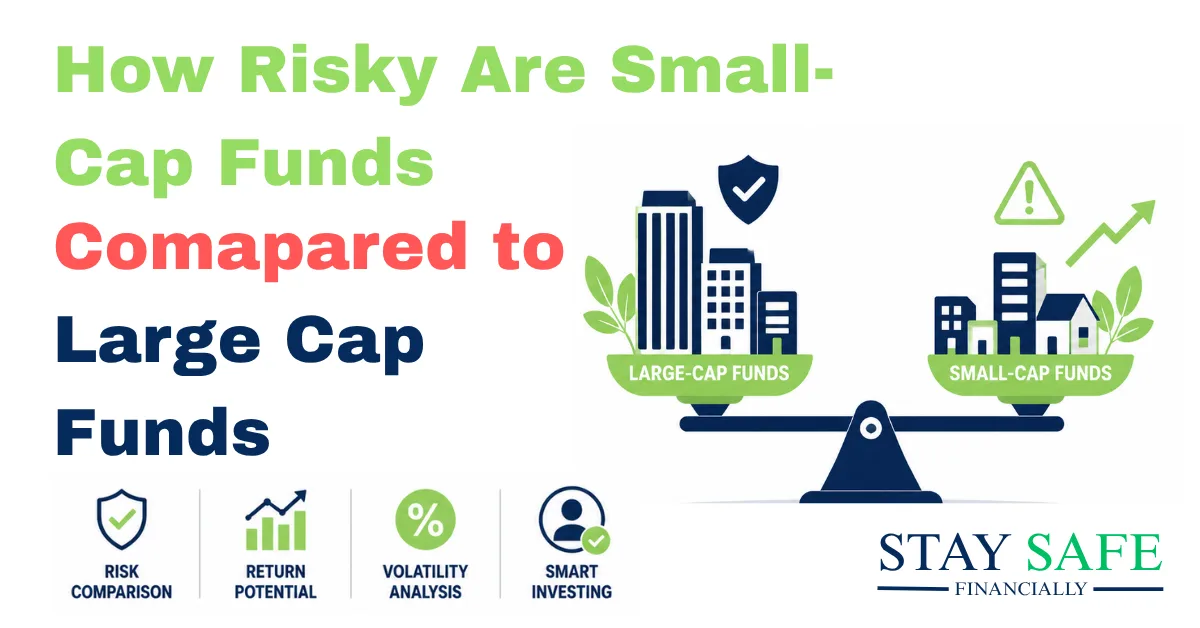
Small cap funds vs large-cap mutual funds: hidden risks, volatility explained, and which option suits your investment goals.
Choosing between Small cap fund and large-cap mutual funds can feel confusing, especially when both promise different kinds of returns. Small-cap funds often look exciting, but their ups and downs can test your patience.
Large-cap funds, on the other hand, offer stability but may grow more slowly. Understanding how risky each option really is can help you invest with confidence, not guesswork.
Table of Contents Small Cap Fund
Why Small Cap Fund Stocks Are Outperforming the Nifty 50
While the Nifty 50 index has remained flat over the past year, Small Cap Fund companies have shown impressive performance. The simple reason for this is that Small Cap Fund companies are reporting robust earnings growth, whereas companies in the Nifty index are seeing negligible growth.
Performance Comparison Between Nifty and Small-Cap Indices
We look at the data for the last year, the Nifty has yielded no returns; in contrast, the Nifty Small cap fund 100 and 250 indices are showing returns of around 15%. Not long ago, the small-cap index posted negative returns over two years, but the gains in just the last month have wiped out those losses.
Why Small-Caps Are Better for Wealth Creation
That is why we often emphasize the importance of investing in small-cap companies and funds if you truly want to create wealth.
Nifty vs Small-Caps Protection vs Growth
The key distinction is this: invest in the Nifty if you want portfolio protection, but if you seek wealth growth and have the patience and ability to withstand volatility, then investing in small-cap funds and indices will generate higher returns.
Structure of This Small-Cap Investment Discussion
We will discuss specific companies and funds that you might consider investing in if you are looking to enter the small-cap space right now.
Three Categories of Small-Cap Investment Options
This discussion is divided into three parts. First, we will talk about two funds that carry low risk funds that invest while taking minimal risk. Then, we will cover two funds that take higher risks. Finally, we will discuss an ETF option for those who prefer investing via ETFs rather than active funds, specifically for those who don’t want to get bogged down in the complexities of whether or not the fund is beating the benchmark.
Low-Risk Small-Cap Funds for Conservative Investors
The low-risk funds. Two funds fall into this category.
Axis Small Cap Fund – Strong Downside Protection
The first is the Axis Small Cap Fund; it offers good downside protection and has a consistent performance track record.
Performance, Valuation, and Risk Profile
It consistently beats its benchmark index while delivering returns close to the category average, all without taking excessive risk. Overall, its Price-to-Earnings (P/E) and Price-to-Book (P/B) ratios are comparable to the category average.
Historical Performance and Recent Recovery
While it delivered exceptional returns a few years ago, particularly during the 2019–20 period, its performance dipped slightly starting in 2022, and 2023 was a particularly poor year for it. However, it has been delivering decent returns since then. I wouldn’t say it delivers massive outperformance, but if you are looking for a fund that performs similarly to or slightly better than the benchmark index while offering superior downside protection, the Axis Small Cap Fund could be the right choice.
AUM and Expense Ratio Overview
It has Assets Under Management (AUM) of around ₹24,000 crore and an expense ratio of approximately 0.56%.
Second Low-Risk Small-Cap Fund – Consistent and Value-Oriented
If you are looking for a consistent fund that delivers returns while taking lower risk, you might consider the Axis Small Cap Fund. Next is the fund; its returns have been quite impressive.
Long-Term Performance Across Timeframes
Across 1-year, 2-year, 3-year, and 5-year timeframes, this fund appears to be delivering solid returns. While 2026 wasn’t particularly strong for this fund, it demonstrated consistently strong performance over the preceding three years: 2023, 2024, and 2025.
Launched in 2021, the fund didn’t fare well during 2021–22, but from 2023 onwards, it has shown strong performance and stands out as the top-performing small-cap fund over 5 years. It is also among the best-performing small-cap funds over 2-year and 3-year horizons, all while maintaining a relatively low risk profile.
Valuation Advantage and Low-Risk Strategy
Its Price-to-Earnings (P/E) ratio is roughly half the category average; while the category average P/E is around 26, this fund’s P/E is around 14. You will also observe a lower Price-to-Book (P/B) value. Thus, across various parameters, it is a fund that operates with lower risk.
Portfolio Quality and Stock Selection Strategy
It invests in quality companies, a trend that remains consistent throughout its portfolio, which includes names like Yes Bank, ICICI Lombard, Karnataka Bank, PNB, and PNB Housing Finance. Essentially, the fund tends to allocate a significant portion of its capital to companies with low P/E ratios.
High-Risk Small-Cap Funds for Aggressive Investors
Moving on to funds that take higher risks, Motilal Oswal has always been regarded as a fund house that embraces higher risk.
Motilal Oswal Small Cap Fund – High Risk, High Reward
Within its offerings, the Small Cap Fund has consistently delivered strong performance. It is a two-year-old fund, not a very old one, but it has been the best-performing fund over that period.
Fund Performance and Risk Characteristics
Its performance over the last year has also been good; in fact, it is demonstrating consistent performance across all parameters, including the one-month and three-month timeframes. Looking at its recent performance, the results appear promising. The price-to-earnings (P/E) ratio is on the slightly higher side, though not excessively so.
It doesn’t quite follow the typical pattern seen in other Motilal Oswal funds; the risk profile is slightly on the higher side.
Risky Stock Picks and Portfolio Composition
The companies involved, such as CCL Products, Karur Vysya Bank, Rubicon Research, Dr. Agarwal’s Health, and Campus Activewear, carry a bit more risk. So, in terms of the underlying companies, this fund invests in riskier ventures. However, the rewards have been good so far. While other Motilal Oswal funds haven’t been performing well, this particular fund continues to deliver consistent performance.
Invesco India Small Cap Fund – Aggressive Growth Strategy
Similarly, if we look at the Invesco India Small Cap Fund, it also takes on higher risk.
High Valuation and Risk Indicators
The Price-to-Earnings (P/E) ratio here is around 35, compared to the category average of 26, indicating a higher risk profile. From this perspective and looking at the companies involved, such as S Life Sciences, KIMS, Inter Globe Aviation, and SWGI, the portfolio leans towards the riskier side.
You will also find names like BSE, RBL Bank, Karur Vysya, and others in the mix. The stock selection is indeed riskier; consequently, both the Invesco Small Cap and Motilal Oswal Small Cap funds are considered high-risk options due to the nature of the companies selected.
Portfolio Risk, AUM, and Suitability
The Assets Under Management (AUM) stand at ₹9,200 crore, and the expense ratio is reasonable. Overall, you should consider these two funds only if you are willing to take on higher risk.
ETF Option for Passive Small-Cap Investors
Now, for investors who prefer to avoid active funds entirely, you might want to consider the HDFC Nifty Small Cap 250 ETF.
Index Performance and Market Recovery
We have already discussed its strong performance; looking at the Small Cap fund 250 index, it has delivered returns of approximately 12.5% over the last month and around 15% over the past year, showing a remarkable recovery.
While the Nifty 50 index might give the impression that returns have been lackluster, the real gains have been generated in the small-cap and mid-cap segments; in fact, the mid-cap index appears to be nearing its all-time high, and it is currently just a short distance away from that peak.
HDFC Nifty Small Cap 250 ETF – Low Cost and High Liquidity
So, if you are looking at the Nifty small-cap space, the 250 ETF is a solid option. Specifically, the HDFC ETF is an excellent choice. It features a low expense ratio and offers good liquidity.
Importance of Liquidity in ETF Investing
When dealing with ETFs, it is also crucial to consider liquidity; the ability to actually sell your holdings when you want to is a critical factor.
Final Advice for Investing in Small-Cap Funds
So, these are some of the companies and funds you might consider for your investments. I hope this helps.
Invest Gradually and Maintain a Long-Term View
However, keep in mind that small-cap funds have already delivered strong returns, so it is advisable to invest in a staggered manner at this stage. Also, invest with a long-term perspective and an Understanding that small-cap funds are inherently volatile; returns can sometimes materialize quite suddenly. For instance, a period of two years of underperformance was effectively offset by a surge in performance over just a month or a month and a half.
Understanding Volatility in Small-Cap Investing
Therefore, if you invest in small-cap funds, do so with patience and a long-term outlook.
FAQs: Small-Cap Funds and Small-Cap Investing
1. Are small-cap funds good for long-term investment?
Yes. Small-cap funds are suitable for long-term investors who can stay invested for at least 5–7 years and tolerate short-term volatility. Over the long run, they have higher wealth-creation potential compared to large-cap funds.
2. Why are small-cap stocks outperforming the Nifty 50 right now?
Small-cap stocks are outperforming because many small companies are reporting strong earnings growth, while Nifty 50 companies are seeing slower or negligible growth. This earnings momentum is driving higher returns in small-cap indices.
3. What is the risk of investing in small-cap mutual funds?
Small-cap funds are more volatile than large-cap funds. Their prices can fall sharply during market corrections, and returns may come in short bursts. Investors must be patient and prepared for periods of underperformance.
4. Is it better to invest in small-cap funds or small-cap ETFs?
It depends on investor preference. Small-cap funds may outperform the index but carry fund manager risk. Small-cap ETFs offer low cost, transparency, and index-like returns, making them suitable for passive investors.
5. Should I invest a lump sum or through SIP in small-cap funds?
At current market levels, investing through SIP or staggered investments is generally safer. This helps manage volatility and reduces the risk of entering the market at a peak.
Specialized Investment Fund in India
Explore Specialized Investment Fund (SIF), its categories, taxation, risks, returns, and how it compares with Mutual Funds and PMS in India.
SBI Contra Fund Analysis and Performance
SBI Contra Fund analysis: returns, risk, Sharpe ratio, strategy & outlook. Should you stay invested or exit? Full review for SIP investors in India.
Nippon India large cap fund direct growth
Nippon India Large Cap Fund direct growth beat the index for years but should it? Hidden risks, costs, and buy or hold verdict inside.