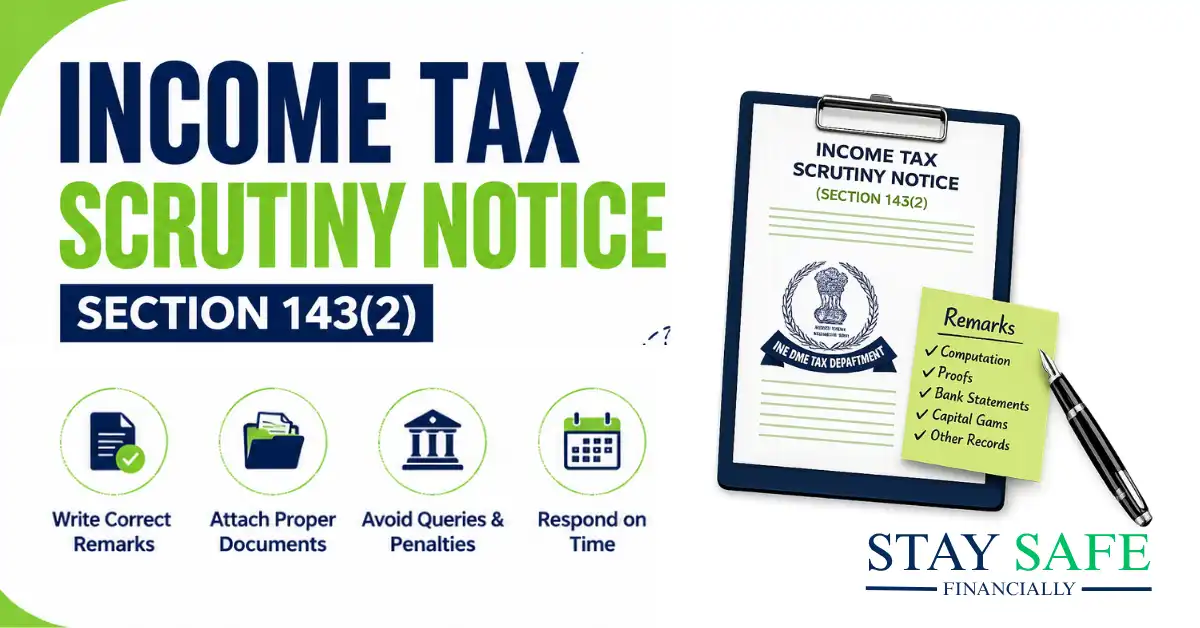
Income tax scrutiny Notice: Learn what to write in the Remarks section under Section 143(2) to avoid queries, penalties, and delays.
Section 143(2) Scrutiny Notice – Complete Guide for AY 2024-25
The Income Tax Department has started sending notices under Section 143(2) for previous years. If you or your client has received a scrutiny assessment notice under Section 143(2), I am going to explain the complete process in today’s session how to reply to it and what documentation is required. Hi guys, I am Vivek from FinTax Pro, where we discuss finance and taxation. Without further ado, let’s start today’s session.
What Is a Section 143(2) Notice?
let’s understand that you likely received two notices: one under Section 143(2) and another under Section 144B.
Difference Between Section 143(2) and Section 144B
The notice under Section 144B relates to ‘faceless assessment,’ while the one under Section 143(2) is for ‘scrutiny assessment’.
Now, what exactly is this assessment, and how does the process work? If you examine the Section 143(2) notice, it begins with, “Dear Taxpayer, Income tax scrutiny Notice the Income Tax Department appreciates your contribution to nation-building.
Assessment Year 2024-25 – Key Deadlines You Must Know
These notices have been issued for Assessment Year 2024-25.
Why Is the Income Tax Department Sending These Notices Now?
Why they are being sent now.
Last Date for Issuing Section 143(2) Notice
The deadline for issuing scrutiny assessment notices under Section 143(2) for Assessment Year 2024-25 is June 30, 2025. Since we are approaching the end of June, Income tax scrutiny Notice the Department is currently issuing a large number of these notices.
The notice acknowledges the care taken in preparing the income tax return but highlights certain issues requiring further clarification.
What Happens During a Scrutiny Assessment?
So, what happens during a scrutiny notice?
Meaning of Scrutiny Assessment Under Income Tax
The department scrutinizes your return, requests relevant documents, computes the tax liability, and conducts a scrutiny assessment. We will understand this entire process in detail, including the documents required. Accordingly, Income tax scrutiny Notice the income tax return has been selected for scrutiny assessment under the provisions of the Income Tax Act, 1961.
You may wonder why your return was selected. This is due to certain risk parameters, which will be explained shortly. Since the notice does not specify the reasons for issuance or the exact documents required, these aspects will be explained, along with guidance on how to submit a response through the portal and which documents need to be uploaded. The steps will be demonstrated during the session.
There is also a notice under Section 144B stating that your case has been assigned to the faceless assessment process. The key point is that you do not need to visit the Income Tax Department in person. Most income tax assessments are now conducted through the faceless assessment mechanism, except in cases such as search and seizure. Faceless assessment means the entire process is conducted online and is transparent. You will not know who is conducting the assessment, as all proceedings take place online.
This relates to your assessment. Questions such as why the notice was issued, what the risk parameters are, how to reply, and which documents to submit will be explained step by step in relation to ITR scrutiny under Section 143(2) for Assessment Year 2024-25.
How the Income Tax Return (ITR) Is Processed
First, you file your ITR. This could be a ‘Nil’ return (where no tax is due), a return with tax payable (where you have already paid the tax), or a return resulting in a refund. Income tax scrutiny Notice Once you file your ITR, it goes into the processing stage.
Role of CPC in ITR Processing
This processing is handled by the CPC (Centralized Processing Center) and is a completely automated, 100% online process. The system checks your documentation and ITR, extracting data from various sources.
Documents Used for Data Matching
These sources include Form 26AS, AIS (Annual Information Statement), TIS (Taxpayer Information Summary), and SFT (Statement of Financial Transactions) reporting; Income tax scrutiny Notice the data is cross-verified against these. After matching the data, an intimation under Section 143(1) is sent to you.
Section 143(1) vs Section 143(2) – Important Differences
I would like to clarify that the notice you received falls under Section 143. The Department conducts a scrutiny assessment under Section 143(2), whereas the communication under Section 143(1) is not technically called a ‘notice’ it is essentially an ‘intimation.’ It serves to inform you that the system has processed your ITR.
What Is an Intimation Under Section 143(1)?
So, an intimation is sent under Section 143(1), while a notice for scrutiny assessment is issued under Section 143(2). Therefore, if you have received a communication under Section 143(1), there is no need to panic. It is simply an intimation that every taxpayer who files an ITR receives a Section 143(1) intimation, which is a very routine matter.
What does it entail? If the CPC is satisfied with your ITR, there will be no outstanding dues. However, if there are issues regarding deductions or exemptions, or a mismatch in TDS, a tax demand might be raised, or if applicable a refund might be generated. Income tax scrutiny Notice Crucially, this is a 100% automated process; there is no manual intervention, as the entire procedure is handled by the CPC.
Risk Parameters That Trigger a Section 143(2) Notice
Moving on, let us consider the risk parameters factors that flag your ITR and increase the likelihood of receiving a notice.
Common Reasons for ITR Selection
I have listed a few examples here:
High-Value Transactions and Cash Deposits
high-value transactions appearing in your AIS (Annual Information Statement) that were not included in your ITR filing; significant cash deposits; Income tax scrutiny Notice a mismatch between your reported income and your GST turnover;
Income Mismatch With AIS, TIS, and Form 26AS
or discrepancies where the income reflected in your AIS, TIS (Taxpayer Information Summary), and Form 26AS differs from what you declared, effectively resulting in an under-reporting of income in your ITR.
High Refund Claims
An excessively high refund claim is a scenario you may encounter frequently now. Refund claims exceeding ₹2 lakh may attract closer Income tax scrutiny Notice and can result in your case being flagged for review.
The government has also become stricter regarding political party donations; if deductions under these sections are claimed, the likelihood of receiving a notice may increase. Other triggers include claiming exemptions or deductions in your ITR that are not reflected in Form 16. Income tax scrutiny Notice This is only an indicative list, as the Income Tax Department uses several other parameters to decide whether an ITR is selected for scrutiny.
Once the selection process begins, the department evaluates whether the case falls within specific risk parameters, including those mentioned above as well as others. If the case falls within these parameters, the department proceeds with further examination based on its internal assessment criteria.
Why Some Taxpayers Receive Notices While Others Don’t
You might wonder why you received a notice when a friend who did the same thing did not. The reason is that even if a case falls within risk parameters, the department applies additional selection filters and does not issue notices in every instance.
Based on approximately 1.65 lakh notices issued for Assessment Year (AY) 2024-25 against around 7 to 8 crore ITRs filed, the selection rate is less than 1%. Income tax scrutiny Notice This shows that scrutiny selection is a routine, periodic process rather than an indication that the department has suddenly become stricter.
The department selects certain ITRs each year based on defined risk parameters. In addition, its assessment may consider potential revenue impact. For example, between a case involving a refund of ₹2,000 and another involving ₹2.5 lakh, both flagged under similar risk parameters, the financial exposure is significantly higher in the latter case.
Department’s Financial Interest and Case Selection
Since the department has limited resources, they will prioritize the case where the financial impact is greater. In other words, they would prefer to scrutinize the case involving the ₹2.5 lakh refund rather than the one with the ₹2,000 refund. I cannot point to a specific document stating this rule, but these are the parameters that operate in the background.
Income tax scrutiny Notice Under the Faceless Assessment Scheme, all these aspects are examined, after which a notice is issued to you specifically, a notice under Section 143(2). Please note that the deadline for Section 143(2) notices for the Assessment Year 2024-25 is June 30, 2025. Regarding the types of assessments, there are three main categories you should be aware of.
Self-Assessment
The first is ‘Self-Assessment.’ What exactly is self-assessment? In India, both the GST and Income Tax systems operate on a self-assessment basis. You prepare your own tax computation and declare to the government: “This is my income, and this is the tax I am paying on it.” Income tax scrutiny Notice This constitutes self-assessment tax.
Income tax scrutiny Notice Essentially, when you file your Income Tax Return (ITR), it is done on a self-assessment basis meaning the taxpayer assesses their own tax liability; hence the term ‘self-assessment.’ Once the return is filed, the department reserves the right to scrutinize and verify it. When the department scrutinizes your return, two options arise: ‘Fair Judgment Assessment’ and ‘Best Judgment Assessment.’ Let me explain when each applies.
Fair Judgment (Regular) Assessment
A ‘Fair Judgment Assessment’ occurs when, for instance, you receive a notice and submit a reply (a process I will teach you shortly). You upload all relevant documents, computations, and information. Based on these, the department computes your tax liability and issues an assessment order. This process is known as ‘Fair Judgment Assessment’ or ‘Regular Assessment.’ Income tax scrutiny Notice This is also referred to as a scrutiny assessment. In this process, you submit all the required documents to the department; they conduct a full computation and subsequently issue an order. This is known as a regular assessment.
Best Judgment Assessment
However, situations often arise where a taxpayer receives such a notice but ignores it, failing to provide any reply. Even after the department sends a follow-up intimation, the taxpayer still does not respond. Ultimately, the department issues a ‘Best Judgment Assessment.’ Income tax scrutiny Notice Under this procedure, an order is passed and a tax demand raised based solely on the information available to the department.
Essentially, a Best Judgment Assessment is an *ex parte* order issued by the department; since you did not reply to the notice or provide any documentation, the department passes an assessment order based on its own best judgment. Now, let’s discuss the assessment procedure specifically, Income tax scrutiny Notice how it works and how you need to navigate the entire process (I will also demonstrate this on the portal).
Documents Required for Scrutiny Assessment
First, the taxpayer is required to submit certain documents. You might ask, “Which documents exactly?”
Mandatory Documents List
To begin with, you need to submit your detailed computation of income.
Bank Statements and Income Proof
Next, submit your bank statements.
Business Income Documents (PGBP)
Regarding the balance sheet, Profit & Loss (P&L) statement, and GST returns: if you have reported business income (PGBP), you must provide these documents as well. Income tax scrutiny Notice You will also need to submit Form 16 and pay slips specifically, pay slips covering the full 12-month period.
Capital Gains and Investment Proofs
Additionally, you must provide capital gains reports, including the “Tax P&L” statement from brokers like Zerodha or similar statements for equity shares from other brokers. You should also provide your home loan certificate. While no documents are required when filing an ITR under self-assessment, all these documents must be submitted as proof during a regular or scrutiny assessment. Only then will the department be satisfied and issue a fair assessment order.
If you hold a Fixed Deposit (FD), submit the FD statement so that interest income under “Income from Other Sources” can be verified. You may also submit income tax challans for taxes paid; although these details usually appear automatically in the system, providing them is beneficial. Income tax scrutiny Notice Regarding TDS and TCS certificates, these details are generally reflected in Form 26AS, but you should attach the certificates if available.
What If You Claimed Wrong or Fake Deductions?
If you claimed fake deductions or exemptions, you can rectify the situation by correcting your tax computation and submitting the revised figures.I will explain the applicable tax and penalty amounts and the payment process shortly.
However, a thought might cross your mind: “What if I create a fake rent receipt to justify the HRA deduction I claimed, even though I don’t actually pay any rent?” Look, there is a difference between a simple mistake and compounding that mistake. Income tax scrutiny Notice If you made an error by claiming a fake or bogus deduction in your ITR, that is one thing the department is now conducting an assessment, so you should simply rectify the error, pay the penalty, and settle any additional tax liability.
Why You Should Not Submit Fake Documents
If you compound the mistake, the consequences will be far more severe. Penalties can be heavy, and provisions for prosecution may even be invoked. Therefore, continuing with fraudulent practices such as submitting fake rent receipts or fabricated LIC receipts after an initial error is strongly discouraged.
Your documents will now undergo detailed verification, and third-party checks are possible; for example, the department may contact LIC to verify receipts issued against your PAN. Income tax scrutiny Notice It is advisable to avoid any further fraudulent activity. What is done is done, but at this stage you must prepare and submit a computation based on accurate reporting and actual documents.
After that, you submit the documents. Submitting documents does not mean the case is closed immediately; the department will verify them. This is a long-term process involving multiple stages. You submit a reply, the department raises further questions, seeks additional documents or explanations, and you must respond accordingly. Further clarification may be required, Income tax scrutiny Notice which you need to explain in detail. It is a lengthy process involving ongoing communication with the department, and it is entirely faceless, meaning all proceedings are handled online.
Final Assessment Order and Appeal Process
Finally, once the Assessing Officer is satisfied with all the documents, a final assessment order is passed. If everything is found to be in order meaning you claimed the correct deductions and exemptions there is no issue; no additional tax liability is added, and the case is closed.
When Penalty Is Imposed
But if the department perceives an issue, such as a problem with your documentation or a deduction you claimed but were not eligible for, the outcome can change. Income tax scrutiny Notice Sometimes taxpayers believe they are eligible for a deduction, but the interpretation under the Act may differ.
For example, taxpayers often assume that any tuition fee paid to a private coaching center for a child can be claimed under Section 80C. Income tax scrutiny Notice However, tuition fees eligible under Section 80C apply only to specific types of educational institutions. Income tax scrutiny Notice Payments made to private coaching centers cannot be claimed under this provision. Such claims may arise from misunderstanding or lack of awareness of the legal provisions rather than intent.
In such cases, the Income Tax Department will determine the correct tax liability and may impose a penalty. Since the department is conducting an assessment, a penalty may be levied, and additional tax may become payable.
If the taxpayer is not satisfied with the assessment order, they may choose to file an appeal against it. Let us now understand the appeals process.
Income Tax Appeal Hierarchy
The first appellate authority is the CIT(A) the Commissioner of Income Tax (Appeals). You would approach the CIT(A), who will pass an order, after which a specific hierarchy is followed. Income tax scrutiny Notice After the CIT(A), the next step is the ITAT (Income Tax Appellate Tribunal), followed by the High Court and the Supreme Court. The Supreme Court is the apex court, and its verdict is binding on everyone. That covers the entire appeals process.
Step-by-Step Process to Reply on Income Tax Portal
Now, let’s go straight to the Income Tax portal, and I will show you how to attach documents and submit a response. We are now on the Income Tax portal; first, please log in to your account.
How to Download the Notice
After logging in, you need to go to ‘Pending Actions,’ where you will find ‘e-Proceedings.’ Navigate to the ‘e-Proceedings’ section. Income tax scrutiny Notice There, you will see notices for the Assessment Year 2024-25; click on ‘View Notices.’ You will see two notices here. If you download the notice letter PDF, the notices I showed you earlier will be downloaded.
How to Request an Adjournment
There is another option I would like to discuss: the option to view or request an adjournment. Sometimes, you may need to reply to a notice in this case, the deadline is July 8th but gathering all the necessary documents and information might take a bit longer. Income tax scrutiny Notice This is where the adjournment option becomes very important; you can click here to request more time.
You must provide a valid reason to the department for seeking the adjournment such as the time required for documentation or the preparation of specific records like balance sheets or P&L statements (even if finalized, extracting the data or trial balances takes time). Income tax scrutiny Notice In my experience, adjournments are generally granted. So, if you need more time to gather documents, collect information, or prepare the tax computation, you can opt for an adjournment.
How to Submit Response and Upload Documents
Now, let’s move on to a crucial step: submitting the response. Let me explain what needs to be submitted. First, click on “Submit Response.” Before proceeding, please read the provided information. You can upload PDF, Excel, and CSV files here. Income tax scrutiny Notice Ensure that any documents you upload are crystal clear and legible, clearly showing the information required for a proper assessment. Click “Continue,” and you will be presented with the option to submit your response.
As I mentioned earlier, simply submitting a response doesn’t mean the entire process is over. You will submit a response and attach the necessary documents, after which your assessment will take place; you may be asked questions or required to provide explanations that is the subsequent stage. Income tax scrutiny Notice For now, the immediate first step is to attach the documents here.
What to Write in the Remarks Section
Income tax scrutiny Notice You might ask, “What should I write in the ‘Remarks’ section?” In the remarks, you should state that the detailed computation for Assessment Year 2024-25 along with proofs of income, exemptions, deductions, bank statements, capital gains statements, and other applicable records are being attached for assessment. This indicates that you are submitting all relevant documents for the assessment process.
Attaching documents is crucial because the department is conducting your assessment. Bank statements are mandatory. If you do not attach documents now, the department will ask for them later through a questionnaire. Providing detailed information upfront reduces follow-up questions. Income tax scrutiny Notice Withholding information, such as attaching only the computation without supporting documents, creates issues because the income figures must be substantiated.
If you are reporting income under “Profits and Gains of Business or Profession” (PGBP), you must attach the Balance Sheet and P&L statement. Income from “Other Sources,” such as interest, must be verified against your savings bank statement, so that should also be attached. Income tax scrutiny Notice Choose the appropriate document type, such as bank statements or transaction statements. Demat account statements can be uploaded under the transaction statement category.
If a required document is not listed, use the “Others” category and add one or more documents using the “Add Document” button. You may also attach a cash flow statement or any other relevant information, mentioning it accordingly. Attach all supporting proofs along with the computation, then click “Continue” and submit.
Section 144B Faceless Assessment – How to Respond
Now, the question arises: what is covered by Section 143(2), but what about the response required under Section 144B? Let me explain that as well. Income tax scrutiny Notice Here is where you submit the response for Section 144B. You do not need to re-attach all the documents here; you can simply mention the details within the ‘Full Response’ section.
Difference Between Partial and Full Response
There is also an option for a “Partial Response.” If you do not have all the information available at once and wish to upload documents in multiple stages, you can select the “Partial Response” option. For example, if you have uploaded the bank statement and income tax computation but plan to attach the P&L statement and balance sheet later, you can submit a partial response now.
However, ensure that you submit the “Full Response” before the reply deadline expires. Even after submitting a partial response, you can add further documents. Income tax scrutiny Notice Once you submit the “Full Response,” you will not be able to reply further to this notice unless the Department requests additional information or raises further queries.
Under Section 144B, you can mention that all documents required for the computation related to the Section 143(2) notice have already been provided and simply refer to that. Income tax scrutiny Notice Alternatively, if you wish, you may re-upload the same documents, though it is not strictly necessary. The required information has already been provided, and the computation will be processed. Essentially, the Section 144B communication informs you that your case has been assigned to the faceless assessment process, which is why this information is requested.
FAQs Income Tax Scrutiny Notice (Section 143(2))
Q1. What is an Income Tax Scrutiny Notice under Section 143(2)?
An Income Tax Scrutiny Notice under Section 143(2) is issued when the Income Tax Department wants to verify the correctness of your filed ITR by examining documents and explanations.
Q2. Is receiving an Income Tax Scrutiny Notice a serious issue?
No. It is a routine process. It does not mean wrongdoing. It only means the department wants clarification or supporting documents for certain details in your return.
Q3. What should I write in the Remarks section while replying to a scrutiny notice?
In the Remarks section, you should mention that you are submitting the detailed computation of income along with supporting documents such as bank statements, deductions, and income proofs for assessment.
Q4. Which documents are mandatory for replying to a scrutiny notice?
Mandatory documents generally include bank statements, income computation, Form 16, capital gains statements, business P&L and balance sheet (if applicable), and proof of deductions claimed.
Q5. What happens if I do not reply to an Income Tax Scrutiny Notice?
If you fail to reply, the department may pass a Best Judgment Assessment, which can result in higher tax demand, penalties, and interest without considering your explanations.
Top 10 Government Schemes Every Student Should Know in 2025
Explore the most important government-funded student grants, education subsidy programs, and student aid schemes available in 2025.