
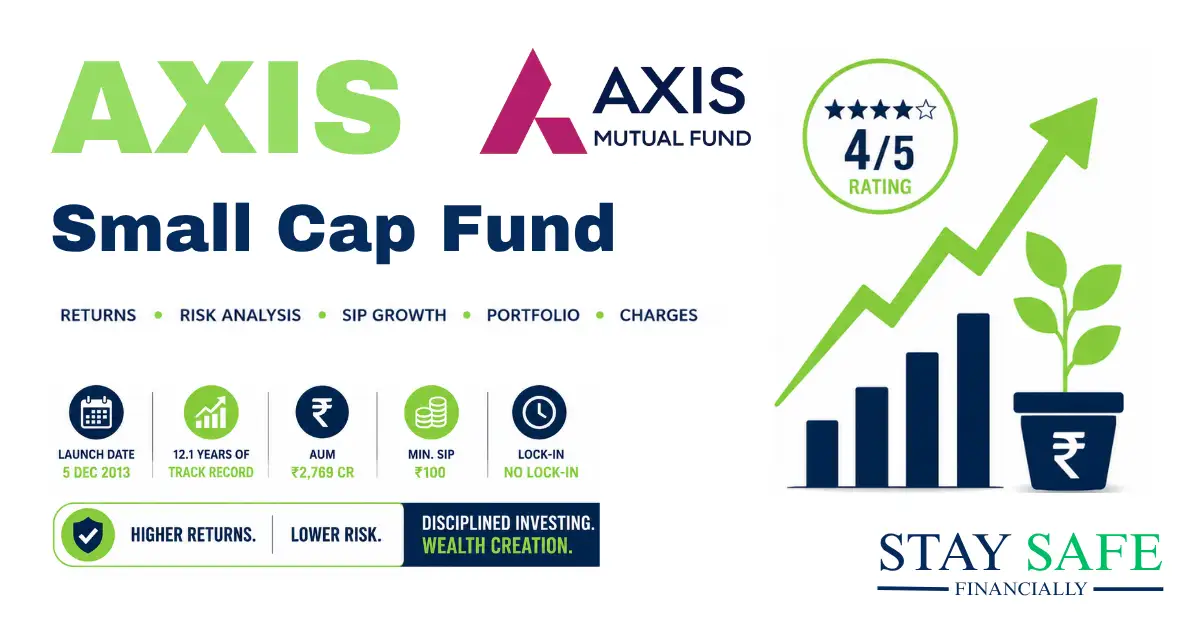
Is Axis Small Cap Fund really worth your money? Explore its returns, risks, SIP details, and long-term potential in a simple, clear breakdown before you invest.
Table of Contents
Axis Small Cap Fund Performance Overview – Returns, History & Growth
The Axis Small Cap Fund. Its launch date was December 5, 2013; effectively, it has been around for 12.1 years. It is a well-established and highly reputed fund.
Axis Small Cap Fund Returns vs Category Average (12-Year Comparison)
The category return over these 12.1 years stands at a massive 21.52%, whereas the Axis Small Cap Fund has delivered an impressive 22.96% return over the same period. You can see that it has outperformed the category average by approximately 1.5%, which is a decent margin over the long term. However, we cannot judge the fund’s quality based on this alone. We need to analyze the details, specifically the level of risk involved and how that risk correlates with the returns generated compared to the category average.
How a 1.5% Extra Return Creates Massive Wealth Over Time
While the returns might appear close to the category average without a massive disparity, that 1.5% outperformance becomes a significant margin over the long run.
SIP Return Example: ₹1,000 Monthly Investment Turned into ₹3.68 Lakha
Suppose you had invested ₹1,000 every month continuously for 10 years in this particular mutual fund. Your total deposit over those 10 years would have been ₹1.2 lakh, which would have grown to ₹3.68 lakh. As you can see, your money would have tripled had you started a ₹1,000 SIP in this specific mutual fund 10 years ago.
Mutual Fund vs Gold vs FD – Which Investment Gave Better Returns?
However, had you invested that ₹1.2 lakh in gold instead of this particular mutual fund, it would have grown to ₹2.10 lakh.
Axis Small Cap Fund vs Gold Returns (10-Year Comparison)
As you can see, your money didn’t quite double; it fell slightly short of doubling. While gold has delivered massive returns over the last two years, its long-term average return hovers around 10–11%.
Mutual Fund vs Fixed Deposit Returns – Why FD Falls Behind
In contrast, if you had invested that same ₹1.2 lakh in a Fixed Deposit (FD), it would have grown to ₹1.74 lakh. This highlights a significant difference between the returns from this mutual fund and an FD. There is also a substantial gap in returns between gold and this mutual fund, but the disparity is even more pronounced when compared to an FD.
Why Long-Term SIP Investing Beats Traditional Options
This underscores the importance of investing; regardless of where you invest, staying invested for the long term allows you to earn decent average returns, especially if you invest consistently through SIPs. Crucially, I have analyzed the risk-to-return ratio of this mutual fund relative to its category; this will help us assess the fund’s risk level and how well it generates returns relative to the risk taken.
Risk Analysis of Axis Small Cap Fund – Beta & Volatility Explained
Here, two parameters are considered: Beta and Standard Deviation.
Beta Explained: How Volatile Is Axis Small Cap Fund vs Benchmark?
Beta essentially indicates volatility relative to the benchmark, specifically, how volatile a particular mutual fund is compared to its benchmark. A value below 1 is generally considered decent, but it is also important for it to be lower than the category average; this indicates that the fund is less volatile while potentially delivering higher returns. In this case, the fund’s Beta is 0.7, whereas the category average is 0.81.
This represents a significant difference in volatility: the category is more volatile, yet the returns generated by the category are lower than those of this specific fund. Since this fund shows lower volatility than the category while simultaneously outperforming it in returns, the assessment regarding Beta and thus risk is highly positive.
Standard Deviation Explained: How Much Can Returns Fluctuate?
Standard Deviation (Risk Measure)
The second parameter is Standard Deviation, which measures how much a fund’s returns can vary above or below its average return. In simple terms, it shows the possible range of returns and helps assess risk.
For example, if a mutual fund has:
- Average return: 10%
- Standard Deviation: 14.32%
The expected return range is calculated as:
- Upper range: 10% + 14.32% = 24.32%
- Lower range: 10% − 14.32% = −4.32%
This means the fund’s annual returns are likely to fluctuate between −4.32% and 24.32%. A higher standard deviation indicates higher volatility and risk, while a lower value suggests more stable returns.
Why Lower Volatility Is a Big Advantage for Long-Term Investors
Lower volatility makes for a favorable situation, as it reduces the level of fluctuation. Here, the figure stands at 14.32, whereas the category average is 16.80.
Axis Small Cap Fund Investment Details – SIP, Lump Sum & Flexibility
Now, suppose you have decided on this particular mutual fund and wish to start an SIP.
Minimum SIP & Lump Sum Investment – Start with Just ₹100
you can begin with a minimum monthly investment of ₹100. Alternatively, if you prefer a lump-sum (one-time) investment in this fund, you can start with just ₹100, which is a very positive feature. Nowadays, even students are starting to invest; with such a low entry amount, they too can invest effectively and earn substantial returns.
Lock-In Period & Exit Rules – Complete Investment Flexibility
Regarding the lock-in period, there is none; you can exit the investment whenever you choose.
Assets Under Management (AUM) – Why Fund Size Matters
As for AUM, it stands for “Assets Under Management.” Essentially, it tells you the total amount of money currently invested in that particular mutual fund.
Ideal AUM Size for Small Cap Mutual Funds Explained
A moderate AUM (Assets Under Management) size is generally considered ideal. If the AUM becomes too large, the fund manager may struggle to manage the portfolio effectively;
Axis Small Cap Fund AUM Analysis – Is ₹2,769 Cr Healthy?
For instance, SIPs or lump-sum investments might be halted, or liquidity issues may arise, making it difficult to cash out or exit the investment. However, a skilled fund manager can often handle a large AUM without significant problems. Conversely, a very low AUM presents a major issue: it suggests a shortcoming in the mutual fund itself, perhaps a lack of investor interest or confidence, which is why capital hasn’t flowed in, resulting in a small AUM.
This creates a negative impression. So, how do you determine the “perfect” AUM size? Here is a useful parameter: if a mutual fund has been operating for 10 to 15 years and has an AUM between ₹100 crore and ₹500 crore, it is considered a healthy size, neither too large nor too small. It remains manageable for the fund manager while also reflecting investor trust. For instance, if a fund has attracted investments totaling around ₹3,6769 crore, the AUM size is viewed very positively.
Expense Ratio of Axis Small Cap Fund – Low Cost Advantage
The expense ratio. You don’t have to do the heavy lifting yourself; that is the fund manager’s job. They apply their expertise to manage your investments and generate good returns. In exchange, they are paid a management fee, which is known as the expense ratio. So, this amounts to about 1% of the investment you have made. Generally, anything below 1% is considered a good figure.
Why a Low Expense Ratio Boosts Long-Term Returns
Regarding the expense ratio: if you are investing for the long term and the expense ratio is around 1%, meaning you are paying that amount as management fees, it can eventually add up to a massive cost (running into lakhs or crores). Ideally, you want to avoid paying high management fees, so an expense ratio below 1% is considered very good. In this case, the ratio is 0.56%, which is an excellent and very low management fee.
Taxation & Exit Load Rules for Axis Small Cap Fund
As for taxation, if you exit (book profits) before one year, you have to pay up to 20% tax on the profits;
Capital Gains Tax on Small-Cap Mutual Funds Explained. If you exit after one year, the tax on profits is 12.5%.
Exit Load Charges – When Do You Pay 1%?
Regarding exit loads: if you exit before one year, you incur an exit load of up to 1%; if you exit after one year, there is no exit load.
Market Capitalisation Allocation – Small, Mid & Large Cap Mix
The most important aspect market capitalization. The allocation is 18.95% in mid-cap, 69.35% in small-cap, 6.03% in large-cap, and 5.67% in debt and other instruments.
SEBI Rules for Small Cap Mutual Funds Allocation
Regarding allocation, SEBI guidelines mandate that for a small-cap category mutual fund, at least 65% of the investment must be in small-cap stocks. The remaining 35% can be invested in large-cap, mid-cap, or even additional small-cap stocks, at the fund manager’s discretion.
However, a minimum allocation of 65% in small-cap stocks is mandatory. In this case, that threshold has been adhered to, with 69.35% allocated to small-cap investments. The remaining portion is distributed across mid-cap and large-cap stocks, as well as debt and other instruments.
Portfolio Allocation Pros & Cons – Risk Impact Explained
My assessment here is neutral, neither entirely positive nor negative. On the positive side, they have complied with the 65% minimum threshold for small-cap stocks (actually exceeding it at 69.35%). However, regarding the remaining ~30% of the portfolio, instead of allocating more to large-cap stocks, they have invested heavily in mid-cap stocks, which increases the risk profile; this is a negative aspect.
Consequently, my overall feedback is average, neither good nor bad. While adhering to the threshold is positive, the lower allocation to large-cap stocks acts as a negative factor. Regarding market capitalization, the feedback is neutral.
Sector Allocation Analysis – Is the Fund Well Diversified?
Looking at the top five sector allocations: Financial Services account for 20.94%, the Industrial sector for 16.95%, Healthcare for 14.53%, Consumer Cyclical for 12.73%, and Basic Materials for 11.41%. If we look at it, they have properly diversified their portfolio across investments, which is a very positive aspect. So, I would certainly give highly positive feedback regarding the sector allocation.
Sector Allocation Analysis – Is the Fund Well Diversified?
As for the fund managers, there are three of them, and they possess significant experience.
Lead Fund Managers Track Record & Experience
The first one is Tejas, who has 1.62 years of experience. He has investments in this particular mutual fund. Let me mention that Tejas Seth previously managed the Nippon India Small Cap Fund; as you can imagine, that fund has delivered excellent returns. He is a renowned and highly experienced fund manager.
While I have noted his experience with the Axis Small Cap Fund as 1.62 years, his overall professional experience actually spans 20 to 22 years, which is substantial. Then there is Mayank, who has 2.39 years of experience with this specific mutual fund, and Krishna N, the third fund manager, who has 1.81 years of experience.
Having experienced fund managers is a major positive, as you can track their past performance and strategies to gauge their track record.
Is the Fund Management Team Size Adequate?
Regarding the number of fund managers, there are three of them, which is appropriate given the AUM (Assets Under Management) size of ₹2,769 crore; three managers are sufficient to handle this portfolio effectively without facing management issues. Thus, the fund scores very positively in terms of manager experience and the size of the management team.
Axis Small Cap Fund Rating Explained – Why It Scores 4/5
As for the rating, it holds a 4 out of 5 rating.
Why Small Cap Mutual Funds Remain High Risk Despite Strong Returns
It is worth noting that the Small Cap category is considered a high-risk segment within mutual funds.
How Some Small Cap Funds Balance Risk and Returns
So, if you want to generate decent returns while taking slightly lower risk, you might want to look into such mutual funds and research them. These funds stand out because they manage to outperform their category, delivering better returns while maintaining a lower risk profile compared to peers. Their strategy focuses on balancing lower risk with solid returns.
Impact of Market Downturns on Small Cap Funds
However, since they belong to the small-cap category, significant risk is inherent and will persist throughout the investment tenure; when the market takes a sharp downturn, these funds will likely fall rapidly.
Suitability for Risk-Conscious Small Cap Investors
Nevertheless, if you are interested in the small-cap space but prefer a slightly more risk-conscious approach to achieving good returns, these funds are worth considering.
Rating Rationale and Portfolio Allocation Concerns
Regarding the rating, I deducted one point because the allocation to large-cap stocks could have been higher; instead, there is a heavier allocation towards mid-cap stocks. That is the specific reason for the deduction, but overall, their past strategy has been absolutely perfect. I would say this is one of the best small-cap funds available.
Why Past Performance Should Not Be the Only Criteria
However, a past strategy does not guarantee that the same approach will be followed in the future. Fund managers change, strategies evolve, and market conditions fluctuate. It depends entirely on the fund manager and the mutual fund house. That said, judging it solely on past performance isn’t always the right approach.
Final Verdict – Should You Invest in Axis Small Cap Fund in 2026?
To conclude: if you have surplus funds, you can invest and simply forget about then you might consider this mutual fund.
Ideal Time Horizon, Risk Warning & Investor Suitability
It is suitable if you have an investment horizon of 7 to 10 years. You should only invest here if you have a separate emergency fund and do not need to withdraw this money during a crisis; otherwise, investing in such a fund carries significant risk. Small-cap funds are inherently very risky, so that risk factor will always remain. Please ensure you conduct your own research before investing, don’t just invest immediately simply because I mentioned it.
Frequently Asked Questions (FAQs)
1. Is Axis Small Cap Fund a good investment in 2026?
Axis Small Cap Fund can be a good option for long-term investors with high risk tolerance. It has outperformed its category with relatively lower volatility, but small-cap risk remains high.
2. What is the ideal investment horizon for Axis Small Cap Fund?
The ideal time horizon is 7 to 10 years or more. Short-term investing is not recommended due to high volatility in small-cap stocks.
3. How risky is Axis Small Cap Fund compared to other small-cap funds?
The fund has a lower beta (0.70) and lower standard deviation (14.32) than the category average, indicating comparatively lower risk within the small-cap segment.
4. What is the minimum SIP amount for Axis Small Cap Fund?
You can start an SIP with as little as ₹100 per month, making it accessible for beginners and small investors.
5. Is Axis Small Cap Fund suitable for conservative investors?
No. Small-cap funds are inherently volatile. Conservative investors should consider large-cap or hybrid funds instead of small-cap schemes.
How Risky Are Small Cap Funds Compared to Large Cap Funds
Small-cap funds vs large-cap mutual funds: hidden risks, volatility explained, and which option suits your investment goals.
SBI Contra Fund Analysis and Performance
SBI Contra Fund analysis: returns, risk, Sharpe ratio, strategy & outlook. Should you stay invested or exit? Full review for SIP investors in India.
Specialized Investment Fund in India
Explore Specialized Investment Fund (SIF), its categories, taxation, risks, returns, and how it compares with Mutual Funds and PMS in India.